Governor Gavin Newsom signed California senate bill 525 (California SB 525) on Oct. 13, 2023, rolling out a new minimum wage standard for healthcare workers. California SB 525 impacts most California healthcare employees and facilities, setting the new standard at $25 per hour, increasing wages up to 30% beginning June 1, 2024.
Impacted healthcare employees — and employers
California SB 525 sets a new salary threshold for exempt healthcare employees. This legislation will have broad-reaching impacts on California healthcare employers, whether or not they’re directly subject to these requirements, as salary expectations will increase for the entire market.
Covered employees
Covered employees, per California SB 525, are those providing patient care and services supporting providing healthcare, or members of a healthcare team including certified nursing assistants, technicians, patient aides, food service workers, housekeeping, medical coders and billers, schedulers, laundry workers, and more — including contract workers. The expansive definition is designed to combat the shortage of healthcare workers in the state of California.
Employees not covered
Outside salespeople, public sector employees who don’t perform healthcare services, delivery or waste collectors not covered by a healthcare facility, and medical transport service workers who aren’t employed by a covered healthcare facility are among workers who don’t qualify.
Impact on employers
Nearly all healthcare employers will be required to implement these new minimum wage standards except hospitals controlled by the California Department of State Hospitals, Tribal clinics exempt from licensure, and outpatient settings operated by Tribal organizations.
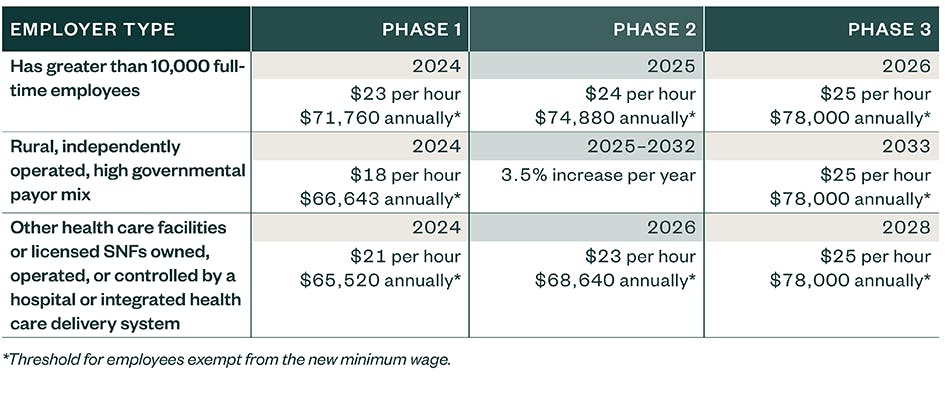
This law also limits a healthcare employer’s ability to meet the salary threshold required for most exemptions from overtime pay and minimum wage. Employers can avoid paying the new minimum wage and overtime to salaried employees earning a monthly salary that’s no less than 150% of the healthcare worker minimum wage or 200% of the applicable minimum wage, whichever is greater, for full-time employment.
By June 2026, most salaried healthcare employees must be making $78,000 annually to be exempt from the new minimum wage and overtime pay requirements.
The California Department of Healthcare Access and Information will publish a list of all covered employers in January 2024. If employers believe they are erroneously listed, they can appeal or apply for a waiver.
Covered healthcare employers
Integrated healthcare delivery systems and hospitals
Integrated delivery or healthcare systems with 10,000 or more full-time equivalent employees as of Jan. 1, 2023, will increase the minimum wage in stages starting at $23 per hour in June 2024, graduating to $25 per hour by 2026. After 2026, the minimum wage will increase according to the rate of inflation or 3.5%, whichever is lower.
Facilities where increase applies
Licensed, acute psychiatric hospitals, and special hospitals as defined in subdivision (f) of the health and safety code
Covered employers with a dialysis clinic or an owner, operator, or controlling entity of a dialysis clinic
Entities operated by counties with a population greater than five million as of Jan. 1, 2023
Psychiatric and mental health facilities
Urgent care clinics
Ambulatory surgical centers
Physician groups
County correctional facilities that provide healthcare
Rural or independent hospitals, clinics, and county-run facilities
Rural and independent hospitals with a high or elevated governmental payor mix, or entities operated by counties with less than 250,000 residents as of Jan. 1, 2023, will see a longer process. These employees will have a new minimum wage starting at $18 per hour in 2024. Every year, this minimum wage will increase by 3.5% yearly until it reaches $25 per hour in 2033. This applies to psychology clinics, specialty care clinics, and dialysis clinics.
Covered facilities that are owned, affiliated, or operated by a county will be required to start complying with the minimum wage schedule beginning January 2025.
SNFs, home healthcare services, and others
For other healthcare facilities that don’t fall in the above categories, including licensed SNFs owned, operated, or controlled by a hospital or healthcare system, the new minimum wage will start at $21 per hour in 2024, increasing to $23 per hour in 2026, until it reaches $25 per hour on June 1, 2028.
Waivers and alternative phase-in schedules
Healthcare employers seeking a waiver or requesting an alternative phase-in schedule need to demonstrate that compliance with these standards would raise considerable doubts about the covered healthcare facility’s ability to continue as a going concern under generally accepted accounting principles (GAAP).
This includes documenting the covered healthcare facility’s financial condition, the condition of any parent or affiliated entity, and evidence of the actual or potential direct financial impact of compliance.
The following must also be specifically addressed when requesting a waiver regarding the covered facility or affiliated entities:
Actual or likely closure of the covered healthcare facility or any affiliated entity
Actual or likely closure of patient services or programs
Actual or likely loss of jobs
Whether the covered healthcare facility is small, rural, frontier, or serves a rural catchment area
Whether closure of the covered healthcare facility would significantly impact access to services in the region or service area
Whether the covered healthcare facility is in financial distress that results or is likely to result in the closure of the covered healthcare facility or any affiliated entity, closure of patient services or programs, or loss of jobs.
Factors to consider in determining financial distress include, covered healthcare facility’s prior and projected performance on financial metrics, like cash on hand, or if the covered healthcare facility has, or is, projected to experience negative operating margins.