
Article
Capitalizing on your next investment by maximizing credits and incentives
April 23, 2013
Whether it’s changing customer demands, compliance with new government regulations, intense competition, or technological advancements, today’s market pressures call for constant change within an organization.
Many market pressures require companies to make investments; if not now, in the very near future. Accordingly, access to capital is critical.
Yet given the overall constrained market liquidity, there are fewer borrowing options than ever before, and investor scrutiny of potential investments has increased.
Perhaps nowhere has the need to respond to market pressures and invest in change been more critical than in the food and beverage industry. Business has been experiencing continued growth in areas such as packaged food products, organic foods, and specialty beverages. This growth has accelerated the need for capital to fund expansions and improvements. According to the United States Department of Agriculture (USDA), while the food and beverage industry has seen steady growth of its US retail sales, developing nations are creating a rapidly growing demand for US food product exports as a large number of these populations are growing in affluence. This combined growth has created new pressures in the production of food and beverage products at many companies’ existing US facilities.
Developing new expansion projects has additional implications that trigger several operational and environmental concerns. Today’s air, water and solids effluents management standards by the Environmental Protection Agency (EPA) and state natural resource agencies have become more stringent by the day. More growth means more waste to manage. Often a processing facility’s growth can be limited by its ability to consistently manage its waste streams.
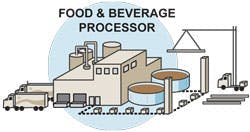
Compounding the matter are elements external to operations that affect a processor’s ability to effectively manage its waste streams, namely the municipal treatment facilities that food and beverage companies rely on. Many treatment plants are already at their prescribed federal and state limits for daily phosphorus, Biological Oxygen Demand, and nitrogen levels, resulting in excess surcharges to processors. What’s more, scores of municipalities have aging infrastructures, with many built 50 years ago. According to a 2009 "U.S. Conference of Mayors Metropolitan Infrastructure Sustainability Study" prepared by GlobeScan and sponsored by Siemens Corporation, three in five cities (59%) identify the lack of funding to meet infrastructure needs as a serious challenge.