Article
Checklist: 12 questions that could help protect your family’s estate
May 10, 2021 · Authored by Torre Hammer
The most essential part of any wealth management plan is preservation. Having the right processes in place can add resiliency to your wealth management practices and help you protect your assets.
In some cases, your wealth was created over many years. To successfully pass it on to future generations, it’s important to continually check that your processes and documents are re-examined, especially after any type of transition. Doing this regularly can build greater confidence that your wealth will be protected and help any transitions go more smoothly.
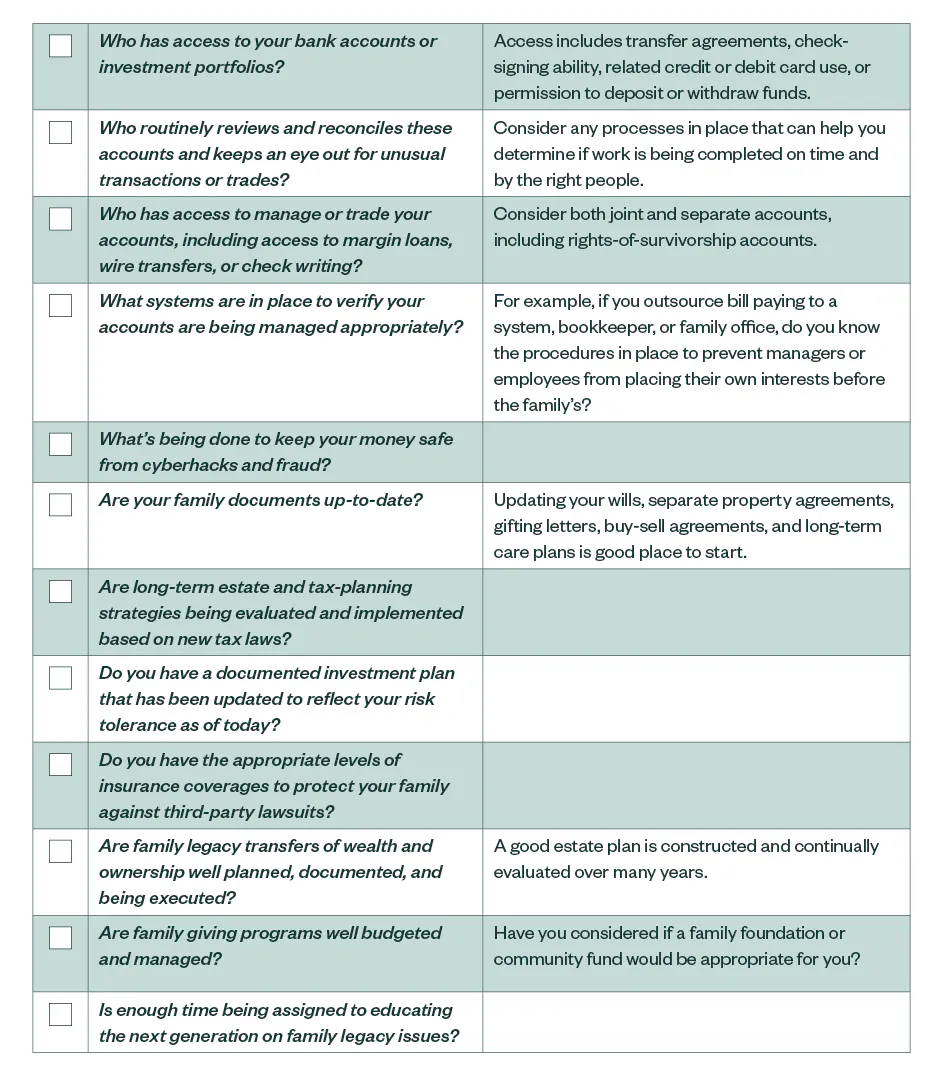
The below 12-question checklist will help you examine your routine so your assets aren’t compromised unnecessarily by complacency. Overall, it’s important to keep in mind three key principles as you’re going through the questions:
- Evaluate who has access to your accounts
- Continuously assess your practices
- Build a reliable plan
Evaluate account access
The remote work trend has exacerbated three conditions that increase the likelihood of someone taking advantage of your assets: pressure, opportunity, and rationalization.
It can be easy to fall into unhelpful habits or routines because they’re familiar. It’s never too late to discover possible areas of vulnerability and establish updated practices to keep your assets safe.
Staying up-to-date with the latest cybersecurity tools will help make sure you also have best practices in place to prevent cyberattacks.
Assess current practices
It’s important to have in place an engaged, responsive, and strategic advisor or team of advisors. Uninformed or hasty decisions could have detrimental consequences.
Your team should continually do the following to protect your finances:
- Evaluate and respond to changing tax codes
- Stay current on estate planning trends and risks
- Make the best use of various investment channels overall

Related sections
The information provided here is of a general nature and is not intended to address the specific circumstances of any individual or entity. In specific circumstances, the services of a professional should be sought. Tax information, if any, contained in this communication was not intended or written to be used by any person for the purpose of avoiding penalties, nor should such information be construed as an opinion upon which any person may rely. The intended recipients of this communication and any attachments are not subject to any limitation on the disclosure of the tax treatment or tax structure of any transaction or matter that is the subject of this communication and any attachments.