Article
How to address data risk in transportation subservice organizations
Feb. 17, 2022 · Authored by Josh Deitch, Mark Meier
Vulnerabilities in the transportation and logistics industry make prime targets for exploitation due to the high value of transactional data, personally identifiable meta data, and proprietary data that supports the complex network of logistics.
In recent years, the United States has seen a steady rise in the number of cyberattacks and ransoms demanded by hackers. Ransomware is a form of malicious software that infiltrates a computer or network and limits or restricts access to critical data by encrypting files until a victim pays ransom often through untraceable cryptocurrency.
The value of confidential data, and by extension, the extraordinary amount of information humans and machines exchange, shouldn’t surprise organizations that support transportation. However, the risk tolerance of data integrity and data loss prevention falls at the mercy of a balancing act between organizational resources and the potential for irreparable damage to transportation organization customer bases.
What is a subservice organization?
The American Institute of Certified Public Accountants (AICPA) defines a subservice organization as a service organization used by another service organization to perform some of the services provided to user entities that are likely to be relevant to those user entities’ internal controls over financial reporting (ICFR).
In today’s business environment, an organization typically outsources certain functions to third parties — service organizations — that may in turn outsource certain functions to subservice organizations. Unfortunately, this can unknowingly leave the organization’s transactional or confidential information at risk.
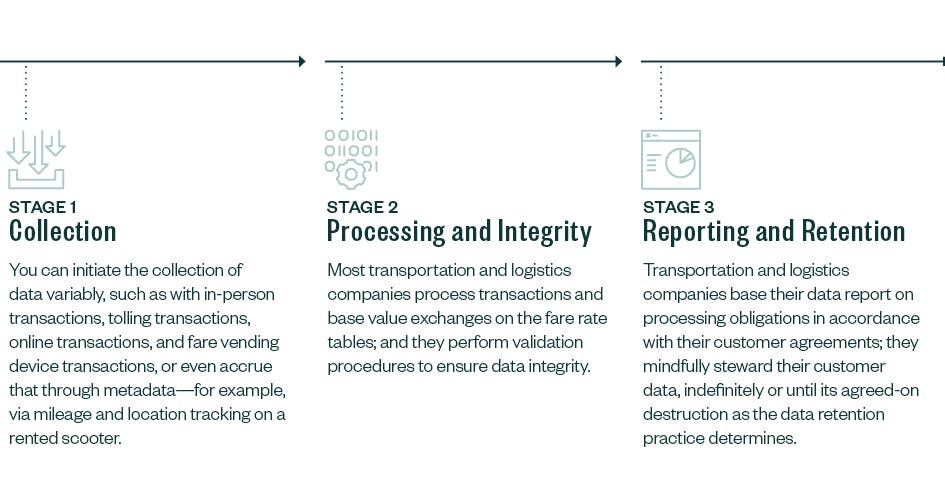
The transactional information cycle
Entities participating in the transportation and logistics industry as a subservice organization have a Transactional Information Cycle which the data goes through.
The stages within the Transactional Information Cycle include: