
Article
American rescue plan extends, expands employee retention credit
Jan. 11, 2021 · Updated Jan. 21, 2022 · Authored by Rob O'Neill, MaryCaitlin Willcuts
The Coronavirus Aid, Relief, and Economic Security (CARES) Act provided an opportunity for employers to generate a refundable tax credit used to offset their employment taxes and apply for a refund for any excess credit generated through Dec. 31, 2020.
The COVID-19-related Tax Relief Act of 2020 further extended the Employee Retention Tax Credit (ERTC) through June 30, 2021. It included certain enhancements that applied starting Jan. 1, 2021.
Then, in March 2021, the American Rescue Plan Act (ARPA) was signed by President Joe Biden — further extending the ERTC through the end of 2021.
Employee retention tax credit update
In November 2021, the Infrastructure Investment and Jobs Act (IIJA) was signed by President Biden, retroactively terminating the ERTC for the fourth quarter of 2021. This limited the availability of ERTC to qualified periods between March 13, 2020, through Sept. 30, 2021.
Below are details about how employers could qualify as well as eligibility requirements.
ERTC eligibility and guidelines
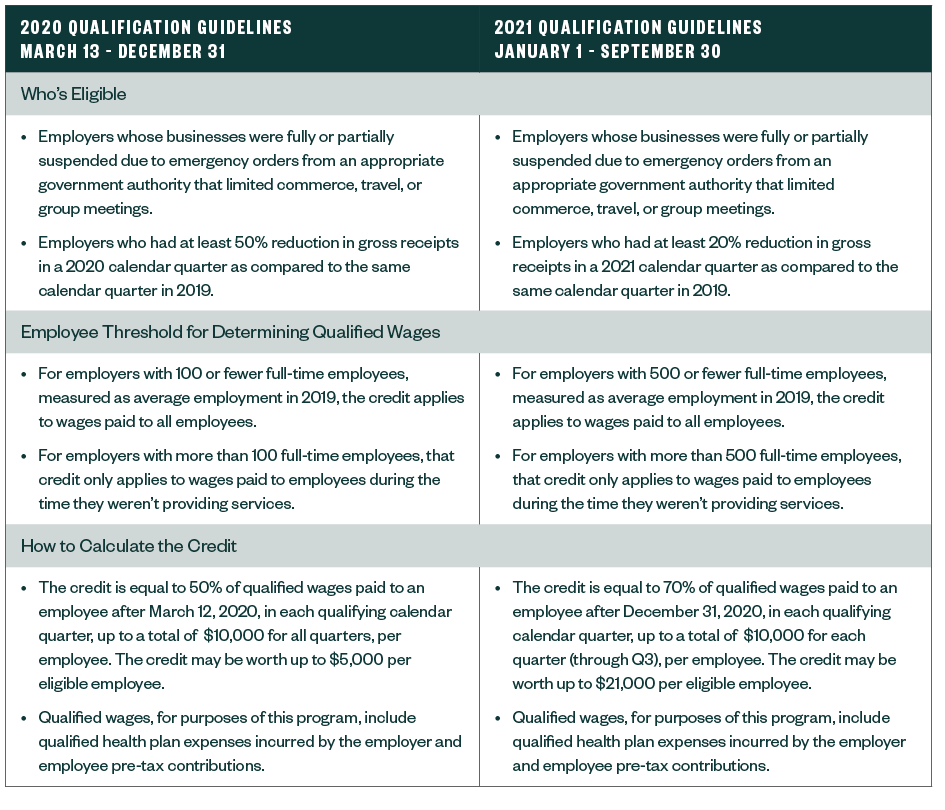
What changes are in the ARPA and IIJA of 2021?
The ARPA includes revisions to the ERTC that apply exclusively to the third and fourth quarters of 2021. One change, for example, specifies that the credit will be applied against an employer’s share of Medicare taxes instead of Social Security taxes. Excess credits will remain refundable.
What is the ERTC qualification period end?
The IIJA retroactively terminated the qualified period for the ERTC to Sept. 30, 2021.
However, businesses that qualify as recovery start-up businesses may continue to claim the ERTC through Dec. 31, 2021. Additionally, employers may still amend returns to apply for the ERTC for all qualified periods.

The information provided here is of a general nature and is not intended to address the specific circumstances of any individual or entity. In specific circumstances, the services of a professional should be sought. Tax information, if any, contained in this communication was not intended or written to be used by any person for the purpose of avoiding penalties, nor should such information be construed as an opinion upon which any person may rely. The intended recipients of this communication and any attachments are not subject to any limitation on the disclosure of the tax treatment or tax structure of any transaction or matter that is the subject of this communication and any attachments.