Mitigating risks with workflow adjustments
As with any law of this scope, organizations should consider workflow adjustments as they prepare for GFE requirements. Adjustments can help mitigate certain risks, like sending the GFE too late.
Timing
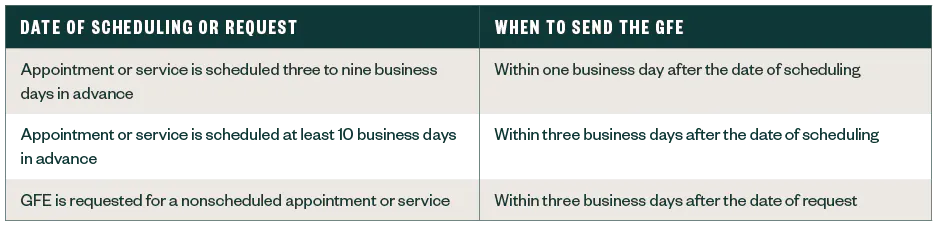
The American Hospital Association (AHA) estimates that it takes 10 to 15 minutes to make a single GFE. Estimates should go out no later than three days after scheduling, depending on the date of appointment. With this fast turnaround, the AHA has noted that facilities need to make operational and workflow changes to comply with the requirement — not just to send GFEs out, but also to monitor compliance systemwide.
How to mitigate
Process, process, process. Providers should establish a clear and repeatable procedure detailing how GFEs will get completed and sent on time, preferably codifying it into formal policy. They should also designate a team with oversight to generate GFEs, send them out, and receive requests.
One potential problem is a lack of controls over which personnel can make appointments when they don’t have the responsibility to generate GFEs. This means communication between the scheduler and the team authorized to generate GFEs is key.
As the AHA notes, automated systems may help expedite some tasks. However, because GFEs are quite customized, complete automation may not be possible.
Internal controls
Given the manual or semi-manual nature of GFE generation, variations will be inevitable if internal controls aren’t in place to standardize GFE workflows.
How to mitigate
Establish internal controls and policies around generating the GFE and monitoring compliance. Use reporting and alerting tools at the point of scheduling to alert the scheduler or other staff that a GFE is required, as well as a form to generate the GFE. Developing tools that assist in preparing for routine services can facilitate workflows while mitigating variation.
Staff training
As workflows adjust, training gaps can further drive variation and noncompliance risk.
How to mitigate
Ensure that trainings and tools get equally distributed across the workforce and cover various areas, from generating the GFE to communicating about it to patients. In addition, make training more dynamic: It should adapt with workflow modifications and regulation changes.
Estimate ranges and complexity
While specificity is the gold standard, a range of costs may sometimes be acceptable for the GFE. As the Centers for Medicare and Medicaid Services (CMS) have indicated, an organization should try to capture all charges.
Some providers, like psychiatrists, may not know how much care planning new patients will need. If you provide a range, try not to make it too big of a range which could pose a compliance risk.
How to mitigate
Create a policy detailing how to approach ranges, such as identifying factors that could result in the lower or higher ends of the range. For example, a psychiatrist might recommend between 10 and 25 sessions at 50 minutes each within a given year, listing a charge at a given rate per session and what that is expected to total at the end of the year.
In highly complex cases communicate with the patient. Understanding their preferences for an item or service — such as whether they want stainless steel or porcelain crowns for dental work, for example — may help narrow the scope of any applicable ranges.
Co-provider and co-facility collaborations (for 2023)
A single GFE should account for the mix of in-house providers, consultations, and follow-up care required for a given course of treatment. After all, the intent is to give patients the full picture of costs for a particular healthcare event.
However, comprehensive care often involves other providers and facilities. This may mean that the facility or provider who schedules the item or service — known as the convening provider — will have to collaborate with co-providers and co-facilities to determine what should go into the GFE. While this specific rule doesn’t take effect until Jan. 1, 2023, it’s a good idea to plan for it now.
How to mitigate
Collaborate with co-providers and co-facilities now to prepare for how the group will comply with the Phase two regulations in January 2023. Have discussions to get familiar with the components that contribute to an accurate GFE. Consider implementing and testing before the due date. Establishing rules of the road prior to the due date to ensure turnaround times, staff training, and controls may be helpful.