Article
Earn tax credits and incentives for your hiring and wage-based practices
April 7, 2024 · Authored by Gina Kucera, Gabriel Sermeno, MaryCaitlin Willcuts
Businesses with certain hiring and wage-based programs could earn tax credits, cash incentives, training reimbursements, and other benefits for their existing practices through federal and state-level programs that aim to encourage job creation and investments in the workforce.
To claim credits and incentives, however, businesses must meet certain eligibility requirements.
Explore opportunities, including credit amounts and qualifications, to determine if your business might be able to leverage these advantages.
Federal hiring and wage-based incentives
- Work Opportunity Tax Credit (WOTC)
- Empowerment Zones
- Disaster Retention Credits
Work opportunity tax credit
The WOTC is a wage-based credit available to employers who hire individuals who may face barriers to employment and qualify under a specified target group. The credit works by offsetting your federal income tax liability.
Here’s an overview of the program.
- Application. Program requires filing applications for new hires with state agencies within 28 days of the hire date.
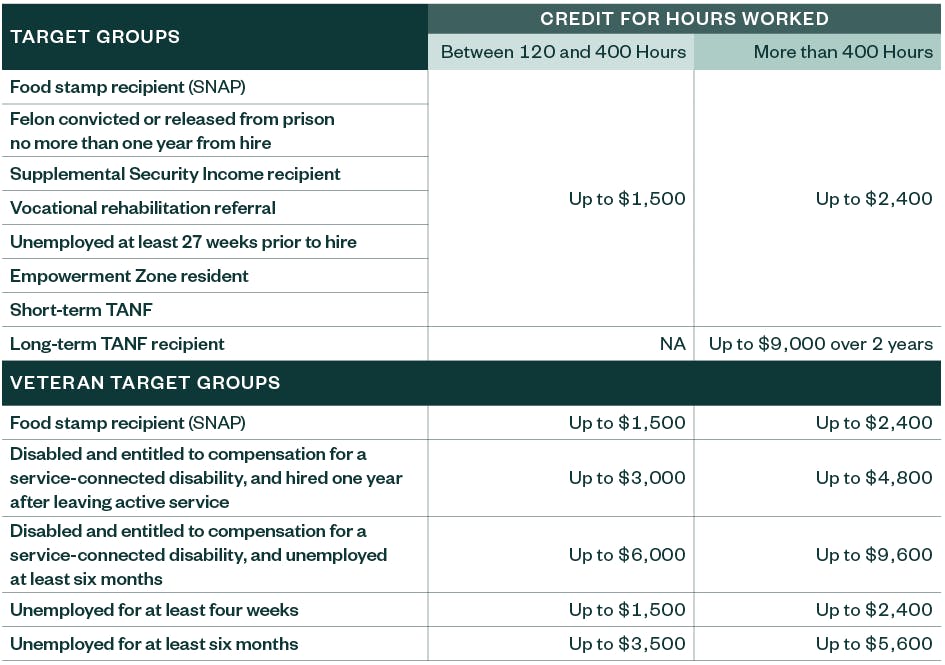
- Credit amount. The value of the tax credit is determined by the number of hours worked and wages earned within first 12 months of employment or 24 months for Long-term Temporary Assistance for Needy Families (TANF).
- Terms. Nontransferable and nonrefundable federal income tax credit that allows a one-year carryback or 20-year carryforward.
- Duration. Active through Dec. 31, 2025 — legislation extended as part of the Consolidated Appropriations Act.
- Qualified hires. One-time credit per qualified new hire — rehired or repeat seasonal employees are ineligible.
Credit amounts for target groups and hours worked


The information provided here is of a general nature and is not intended to address the specific circumstances of any individual or entity. In specific circumstances, the services of a professional should be sought. Tax information, if any, contained in this communication was not intended or written to be used by any person for the purpose of avoiding penalties, nor should such information be construed as an opinion upon which any person may rely. The intended recipients of this communication and any attachments are not subject to any limitation on the disclosure of the tax treatment or tax structure of any transaction or matter that is the subject of this communication and any attachments.