Article
Discover tax savings with the new energy efficient home section 45L tax credit
April 23, 2024 · Authored by Kyle Sund, Matt Lord
Real estate developers and homebuilders who want to reduce their tax burden, and contribute to a greener future in the process, should consider an Internal Revenue Code (IRC) Section 45L tax credit. The following will provide an overview of the credit, its value, eligibility requirements, and the certification process.
What is the section 45L tax credit?
The Section 45L tax credit rewards developers and homebuilders who construct or renovate single family homes, multifamily properties, and manufactured homes that meet the minimum energy-efficiency standards prescribed by ENERGY STAR.
Section 45L of the IRC went into effect in 2006 to incentivize new construction or substantial renovation of energy-efficient single-family homes and multifamily properties.
The Inflation Reduction Act of 2022 implemented significant changes to the Section 45L tax credit.
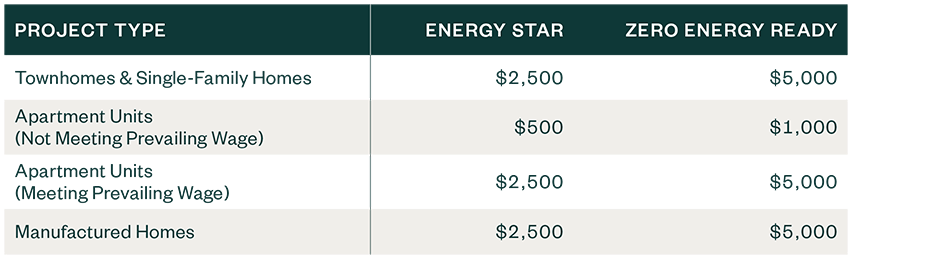
Effective Jan. 1, 2023, the Section 45L tax credit is available to homebuilders and developers through 2032. The credit ranges from $500 to $5,000, per residential dwelling unit, based on the following criteria:
- Type of development
- Applicable ENERGY STAR program
- Paid or unpaid prevailing wage labor rates — there’s no apprenticeship requirement
Section 45L tax credits may be pursued for projects with lease-up or sales before Jan. 1, 2023, with amended tax return filings. Energy efficiency testing for units acquired prior to Jan. 1, 2023, are modeled using IECC 2006 standards and not ENERGY STAR.
When is the section 45L tax credit claimed?
The credit is claimed when the residential units are first sold or leased to another party for use as a residence. The placed-in-service date of the residential units doesn’t impact the tax year the credit can be claimed.

Related sections
The information provided here is of a general nature and is not intended to address the specific circumstances of any individual or entity. In specific circumstances, the services of a professional should be sought. Tax information, if any, contained in this communication was not intended or written to be used by any person for the purpose of avoiding penalties, nor should such information be construed as an opinion upon which any person may rely. The intended recipients of this communication and any attachments are not subject to any limitation on the disclosure of the tax treatment or tax structure of any transaction or matter that is the subject of this communication and any attachments.