Article
Inflation Reduction Act expands section 179D energy-efficient tax incentives
Aug. 17, 2022 · Authored by Kyle Sund
The Inflation Reduction Act of 2022 dramatically increases the Internal Revenue Code (IRC) Section 179D energy-efficient commercial building deduction, making it especially impactful for the architecture, engineering, and construction (AEC) industries as well as commercial building owners.
The act was signed by President Joe Biden on Aug. 16, 2022.
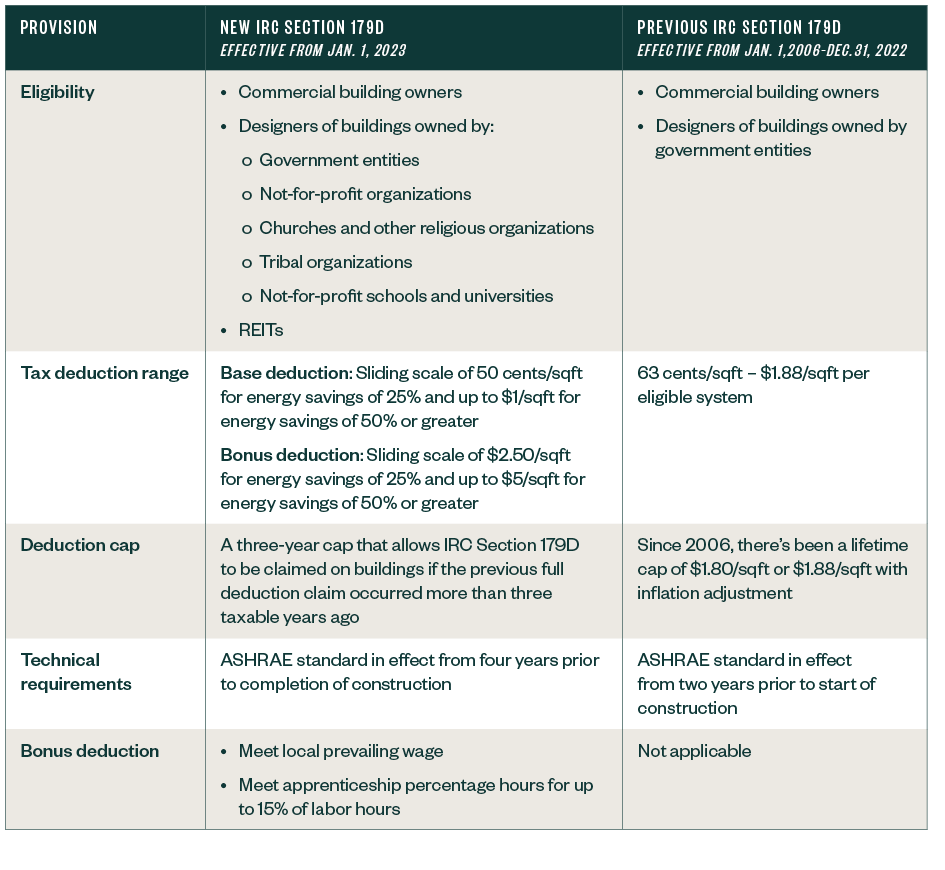
Outline of IRC section 179D changes
These changes are significant and add additional value — and complexity — to IRC Section 179D. They apply to qualifying property placed in service after Dec. 31, 2022.
Who’s eligible?
The Inflation Reduction Act extends the deduction to designers of commercial buildings owned by tax-exempt entities, including not-for-profit organizations, churches and other religious organizations, Tribal organizations, and not-for-profit schools and universities.
This is in addition to current eligibility, which only includes commercial building owners and designers of buildings owned by government entities.
The new provisions in the act expand eligibility for companies claiming IRC Section 179D to include REITs, which are companies that own, operate, or finance income-producing real estate across various property sectors.
Increases qualification thresholds
The act sets the qualification threshold for deductions at 25% energy cost savings, with a base deduction equal to 50 cents per square foot (sq ft) and bonus deduction equal to $2.50/sq ft.
Additionally, it increases the deduction on a sliding scale for each percentage point above 25% when energy usage is reduced. This increase is capped at a 50% reduction with the base deduction set at $1/sq ft and bonus deduction equal to $5/sq ft.
Previously, the tax deduction range was 63 cents/sq ft for each of the three eligible systems, including HVAC and hot water, interior lighting, and building envelope to a maximum value of $1.88/sq ft.
Adds bonus deduction
The bonus deduction previously mentioned is available to companies that meet local prevailing wage and apprenticeship requirements for any laborers and mechanics employed by the taxpayer or contractors associated with the installation. This is a wholly new addition.

The information provided here is of a general nature and is not intended to address the specific circumstances of any individual or entity. In specific circumstances, the services of a professional should be sought. Tax information, if any, contained in this communication was not intended or written to be used by any person for the purpose of avoiding penalties, nor should such information be construed as an opinion upon which any person may rely. The intended recipients of this communication and any attachments are not subject to any limitation on the disclosure of the tax treatment or tax structure of any transaction or matter that is the subject of this communication and any attachments.