
Article
IRS issues guidance for environmental justice solar and wind bonus credits
May 4, 2023 · Authored by Adam DeZego
Loading...
The IRS published Notice 2023-17, which provides guidance and establishes the program to allocate bonus credit percentages for the environmental justice solar and wind capacity limitation under the Inflation Reduction Act, on Feb. 13, 2023.
The environmental justice solar and wind capacity limitation (sometimes referred to as the environmental justice bonus credit or low-income communities bonus credit) allows a taxpayer or applicable entity to be eligible for direct pay under Internal Revenue Code (IRC) Section 6417.
It allows qualifying projects to receive an increased tax credit between 10 and 20 percentage points on top of the tax credit percentage applicable to projects meeting other bonus criteria, such as prevailing wage and apprenticeship requirements.
The broad goals of the credit are to:
To be eligible for the program, applicable entities must be allocated a portion of the available environmental justice solar and wind capacity limitation. The applying solar or wind project must also be treated as energy property under IRC Section 48, generate electricity solely from a wind facility, solar energy property or small wind energy property, have a maximum net output of less than five megawatts alternating current, and be described in at least one of the four following categories:
The facility is located in a low-income community, which is generally defined under IRC Section 45D as a census tract with a poverty rate of at least 20% or in a census tract with a median family income that doesn’t exceed 80% of the metropolitan or statewide median family income, as applicable.
The information provided here is of a general nature and is not intended to address the specific circumstances of any individual or entity. In specific circumstances, the services of a professional should be sought. Tax information, if any, contained in this communication was not intended or written to be used by any person for the purpose of avoiding penalties, nor should such information be construed as an opinion upon which any person may rely. The intended recipients of this communication and any attachments are not subject to any limitation on the disclosure of the tax treatment or tax structure of any transaction or matter that is the subject of this communication and any attachments.
The facility is located on Tribal land.
The facility is part of a qualified low-income residential building project that participates in an affordable housing program and the financial benefits of the electricity produced are allocated equitably among the occupants.
The facility is part of a qualified low-income economic benefit project where at least 50% of the financial benefits of the electricity produced are provided to households with an income of less than 200% of the poverty line or less than 80% of the area median gross income.
Projects that qualify as Category one or two projects and also meet the requirements for Category three or four are considered Category three or four facilities. Electricity acquired at a below-market rate is considered a financial benefit for Category three and four projects. Additional guidance to further clarify the financial benefit will be provided at a later date.
Taxpayers or applicable entities with:
Category one and two projects can apply for a 10 percentage point increase in the eligible credit percentage.
Category three and four projects can apply for a 20 percentage point increase in the eligible credit percentage.
The property must be placed in service within four years of notification that the applicant was awarded a credit percentage increase.
A property is considered placed in service in the year in which the depreciation of the property begins, or the year it’s placed in a state of readiness and availability for a specifically assigned function, whichever is earlier. A property placed in service prior to an award isn’t eligible.
The allocation program is limited to 1.8 gigawatts of direct current capacity each year for calendar years 2023 and 2024. If any excess capacity isn’t allocated, the excess is carried forward to the next calendar year. After 2024, the allocation falls under the IRC Section 48E requirements with guidance regarding program implementation due not later than Jan. 1, 2025.
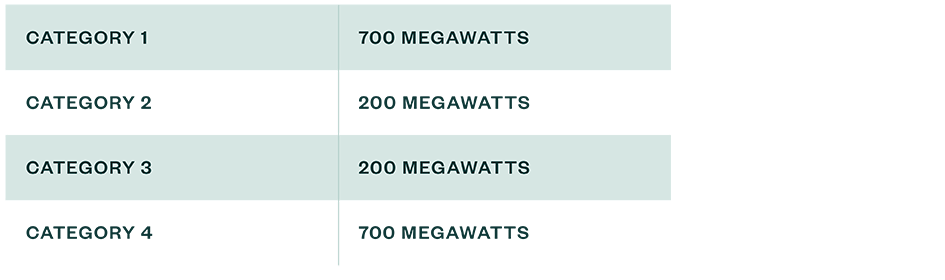
In 2023, the 1.8-gigawatt limitation will be allocated across the four categories of properties as follows:

Additional criteria will be determined on how to allocate the capacity limitation for each of the four categories to further program goals.
Criteria may include a focus on facilities that are owned or developed by community-based organizations, have an impact on encouraging new market participants, provide substantial benefits to low-income communities and individuals marginalized for economic opportunities, and have a higher degree of commercial readiness. Additional guidance will describe these additional criteria.
Should the number of applicants exceed the capacity limitations, a lottery system or other process may be implemented to allocate the environmental justice solar and wind capacity limitation. If a facility category has excess applicants, such excess may be reallocated between the categories in order to maximize allocations.
For each facility, an applicant may apply for an allocation in only one category for the 2023 calendar year. If not successful, an applicant may apply for future allocations. No waitlist will be created.
Applications for an allocation will be accepted in a phased approach for 2023, with 60-day application windows for each phase. It’s anticipated that the applications for Category three and four projects will be begin in Q3 2023. Applications for Category one and two projects will begin thereafter.
The Department of Energy will administer the allocation program including reviewing applications for statutory eligibility; additional guidance will be forthcoming.