
Article
Understanding ASC 842 and GASB 87 lease accounting standards for lessees
June 21, 2023 · Authored by Matthew Dinsdale
Lease accounting is an important aspect of financial reporting that affects both public and private sector entities. In the United States, lease accounting is governed by different standards for different types of entities.
For public entities, including state and local governments, the Governmental Accounting Standards Board (GASB) establishes the financial accounting and reporting standards. For private entities including private companies, public business entities, not-for-profit entities, and employee benefit plans, the Financial Accounting Standards Board (FASB) establishes the financial accounting and reporting standards under the Accounting Standards Codification (ASC).
This article focuses on the differences in lease accounting between ASC 842 and GASB 87 related to accounting for lessees.
Overview of ASC 842 and GASB 87
ASC 842, Leases, is the lease accounting standard issued by the FASB, which applies to private entities in the United States. It replaced the previous standard, ASC 840, and was effective for public companies, certain not-for-profit entities and certain employee benefit plans for fiscal years beginning after Dec. 15, 2018, and for private companies for fiscal years beginning after Dec. 15, 2021.
GASB 87, Leases, is the lease accounting standard issued by the GASB, which applies to state and local governments in the United States. It replaced the previous standard, GASB 62, and was effective for fiscal years beginning after June 15, 2021.
Comparison of ASC 842 and GASB 87
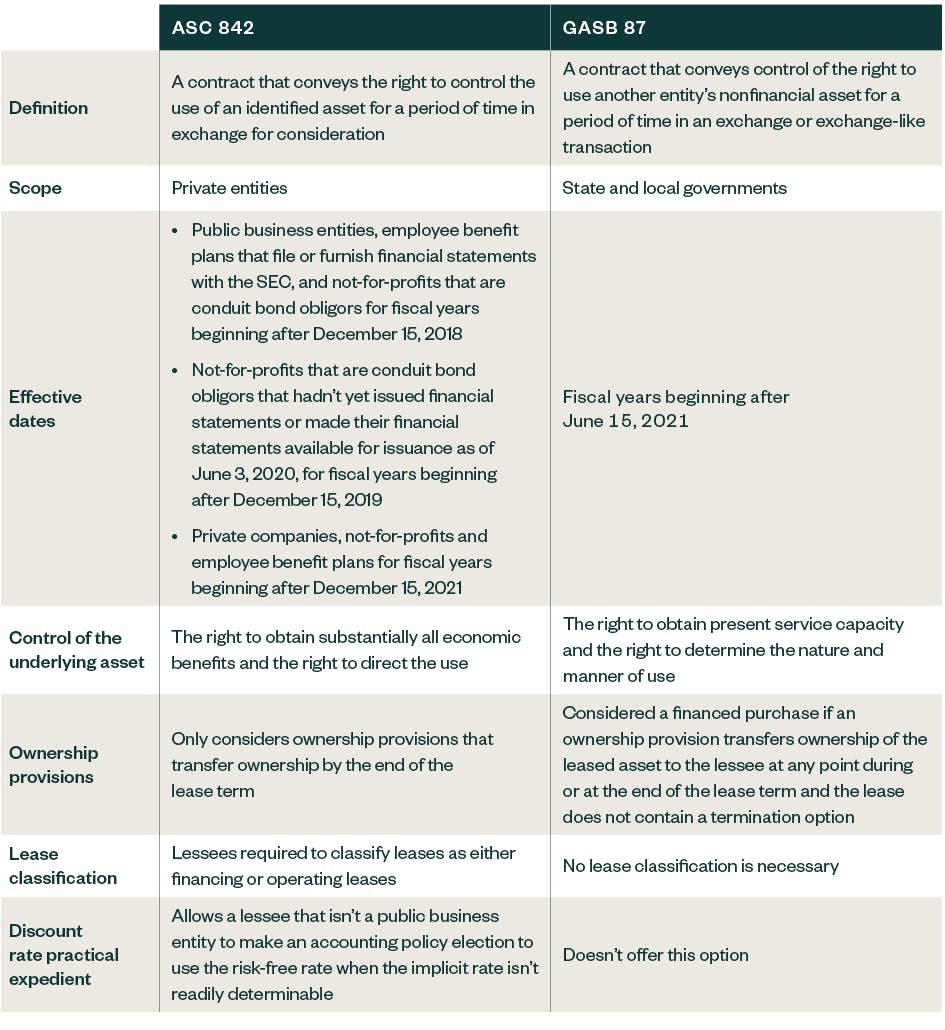
Six key differences in lease definition
Definitions
One of the key differences between ASC 842 and GASB 87 is how each defines a lease. ASC 842 defines a lease as a contract, or part of a contract, that conveys the right to control the use of an identified asset for a period of time in exchange for consideration. GASB 87 defines a lease as a contract that conveys the right to control the right to use of a nonfinancial asset for a period in an exchange-like transaction.
