Article
Leverage Oregon’s agribusiness tax credit to offset overtime payments
Aug. 21, 2025 · Authored by Jackie Merrill, Tyson Kohler
With the enactment of House Bill 4002 in February 2022, Oregon’s agricultural employers have been navigating overtime requirements while managing their operational costs. These overtime pay rules for agricultural workers in Oregon have significant implications for agribusinesses.
This legislation also introduced the Agricultural employer overtime tax credit (AEOTC), designed to alleviate some of the financial pressures associated with these changes.
Discover how these laws can impact Oregon’s agribusiness, what they mean for business owners and how to leverage this opportunity with the following insights.
Background: Overtime requirements
Beginning in 2023, agricultural employers in Oregon must provide overtime pay to workers exceeding certain weekly hour thresholds. The implementation of these thresholds occur over several years:
- 2023–2024: Overtime after 55 hours per week
- 2025–2026: Overtime after 48 hours per week
- 2027 onward: Overtime after 40 hours per week
These requirements apply broadly across the agricultural sector, with specific exemptions for immediate family members, certain hand harvesters, and workers primarily engaged in livestock range production.
Understanding Oregon's agricultural employer overtime tax credit (AEOTC)
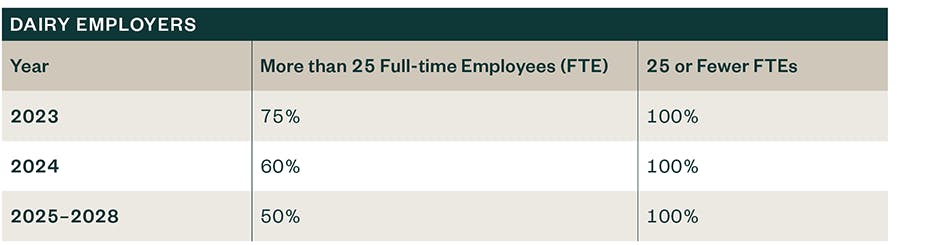
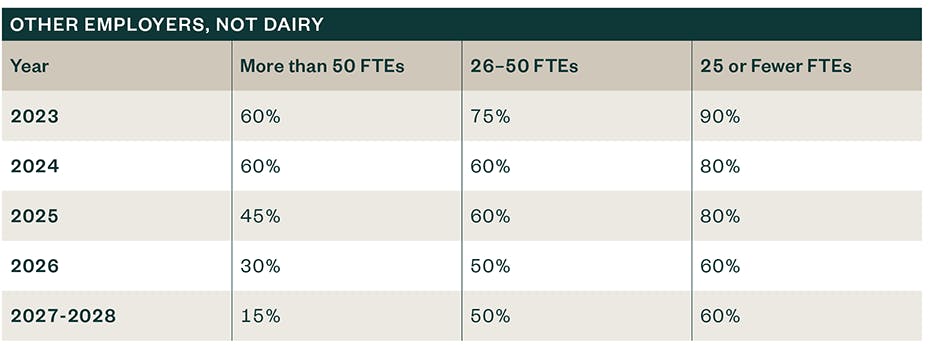
The AEOTC is a refundable tax credit available to agricultural employers who pay overtime wages to eligible workers. Effective from 2023 through the 2028 calendar year, this credit is intended to support employers during the transition to the new overtime pay structure. Unlike traditional payroll tax credits, the AEOTC is claimed on income tax returns, allowing employers to receive a refund if the credit exceeds their tax liability.
The AEOTC structure
The AEOTC is structured to help agricultural employers manage the financial impact of the new overtime requirements. The credit is calculated based on a percentage of the difference between the overtime pay and the base wage for hours worked beyond the specified thresholds.
Related sections
The information provided here is of a general nature and is not intended to address the specific circumstances of any individual or entity. In specific circumstances, the services of a professional should be sought. Tax information, if any, contained in this communication was not intended or written to be used by any person for the purpose of avoiding penalties, nor should such information be construed as an opinion upon which any person may rely. The intended recipients of this communication and any attachments are not subject to any limitation on the disclosure of the tax treatment or tax structure of any transaction or matter that is the subject of this communication and any attachments.