Article
How to know if your hospital qualifies for the Medicare DSH reimbursement
April 8, 2020 · Authored by Jonathan Mason, Michael Newell
When it comes to Medicare provider reimbursement, Worksheet S-10 has captured the provider reimbursement community’s attention. But it’s important not to lose sight of the Medicare Disproportionate Share Hospital (DSH) program.
Medicare DSH is a $4 billion-plus program in federal fiscal year (FFY) 2020, which makes it a significant and important revenue stream for many hospitals.
Qualification for Medicare DSH is a factor in other reimbursement programs as well. Medicare DSH qualification drives participation in the $8.35 billion Federal Uncompensated Care (UC) pool as well as the 340B Drug Discount Program.
And unlike the UC pool payment, hospitals, in essence, have a greater ability to control their DSH reimbursement; in fact, they have permission to revise it.
It’s common to hear about how overall hospital reimbursement is declining, but Medicare DSH is growing, and hospitals have opportunities to optimize theirs based on how well they report their DSH data.
Following is an overview to help hospitals determine Medicare DSH eligibility and evaluate their Medicare DSH reporting.
What’s the Medicare DSH adjustment?
The original intent of the Medicare DSH payment was to supplement providers who treated higher percentages of low-income Medicare patients because the costs to treat those patients were more expensive.
According to the CMS website, “the Medicare DSH adjustment was enacted by Section 9105 of the Consolidated Omnibus Budget Reconciliation Act (COBRA) of 1985. This program became effective for discharges occurring on or after May 1, 1986.”
What are DSH qualification methods?
According to the section of the Act mentioned above and the CMS website, “there are two methods for a hospital to qualify for the Medicare DSH adjustment.
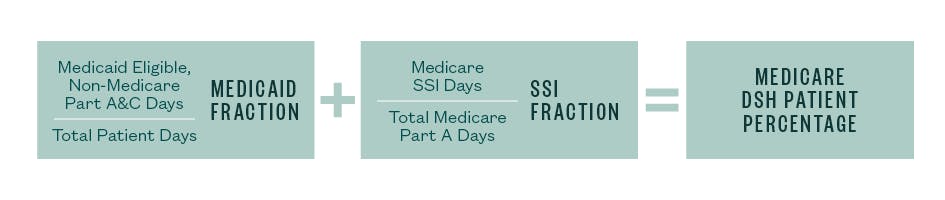
1. The primary method for a hospital to qualify for the Medicare DSH adjustment is based on a statutory formula that results in the DSH patient percentage.” That formula is reviewed below.
2. “The alternate, special exception method is for large urban hospitals that can demonstrate that more than 30% of their total net inpatient care revenues come from State and local governments for indigent care (other than Medicare or Medicaid).” This is referred to as the Pickle Method, and there are very few Pickle hospitals remaining.