
Article
New Portland tax further complicates Oregon’s tax landscape
Sept. 13, 2020 · Updated Nov. 13, 2020 · Authored by Rob O'Neill
Multnomah County voters approved a new personal income tax to fund preschool programs. The tax, effective Jan. 1, 2021, is on individuals who live in Multnomah County or who don’t live in the county but receive income from Multnomah County sources. The tax is 1.5% on income over $125,000 (single) and $200,000 (joint) and 3.0% on income over $250,000 (single) and $400,000 (joint). The tax rates are scheduled to rise to 2.3% and 3.8% after five years.
The new revenue-raiser joins several existing taxes, including a measure passed in May 2020 to fund supportive services for persons who are homeless or at risk of becoming homeless that also becomes effective Jan. 1, 2021.
Here, we outline this new addition and how it fits in with Oregon’s already complex tax landscape.
Oregon state and local taxes
The chart below shows certain current Oregon and local taxes, including the newly passed one.
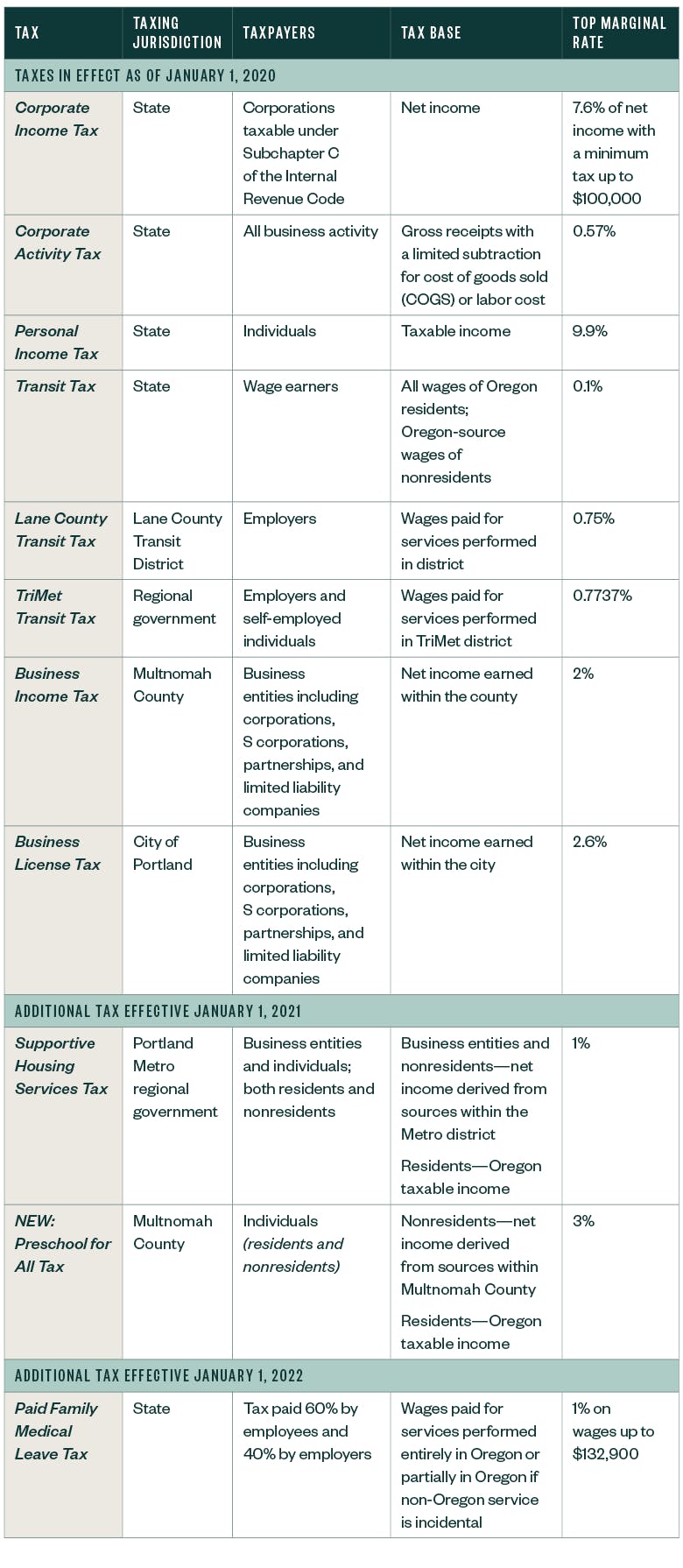
Local Portland governments are imposing several additional taxes with more limited application including:
- CEO surcharge
- Gross receipts tax on certain large retailers
- Heavy vehicle use tax
Implementation considerations
While most of the taxes listed above have been effective for several years with established policies, the Metro Supportive Housing Services and Multnomah County Preschool for All taxes introduce new taxing mechanisms. Several implementation considerations and ambiguities remain to be clarified before the Jan. 1, 2021, effective date, including taxation of income generated by pass-through entities and the status of taxable income of nonresidents.
The COVID-19 pandemic adds additional considerations as many employees who may have worked in Multnomah County or the Metro district in early 2020 may now be working remotely from homes outside the taxing jurisdictions. Further clarification will be needed.
Employers may be required to include the Supportive Housing Services and Preschool for All taxes in their withholding calculations, and all businesses will likely be required to make estimated payments for the tax. Businesses that operate within and without the Metro district must develop procedures to document in-district and out-of-district activities.

The information provided here is of a general nature and is not intended to address the specific circumstances of any individual or entity. In specific circumstances, the services of a professional should be sought. Tax information, if any, contained in this communication was not intended or written to be used by any person for the purpose of avoiding penalties, nor should such information be construed as an opinion upon which any person may rely. The intended recipients of this communication and any attachments are not subject to any limitation on the disclosure of the tax treatment or tax structure of any transaction or matter that is the subject of this communication and any attachments.