Article
How pharmaceutical companies can claim the orphan drug and R&D tax credits
April 11, 2021 · Updated Oct. 9, 2023 · Authored by Rich Croghan, Ray Esquivel, Kunaal Patel
The orphan drug tax credit (ODC) is a federal tax credit available to pharmaceutical companies working to find cures for certain rare diseases that affect small populations. Similar to the traditional research and development (R&D) tax credit, the ODC provides pharmaceutical companies an opportunity to increase cash flow and reduce the cost of development operations.
The qualification requirements for the ODC are similar to traditional R&D credits, as both seek to incentivize conducting research activities that address technical uncertainty through iterative experimentation efforts. However, both credits must be separately calculated, and there are some key nuances to understand.
How much can a company save with orphan drug tax credits versus traditional R&D credits?
Typically, eligible pharmaceutical companies see a higher rate of return on their orphan drug clinical testing expenses (CTE) compared to R&D credit qualified research expenses (QRE). While the federal gross R&D credit typically results in a tax credit of 10% of QRE, the ODC provides a rate of 25% of CTE.
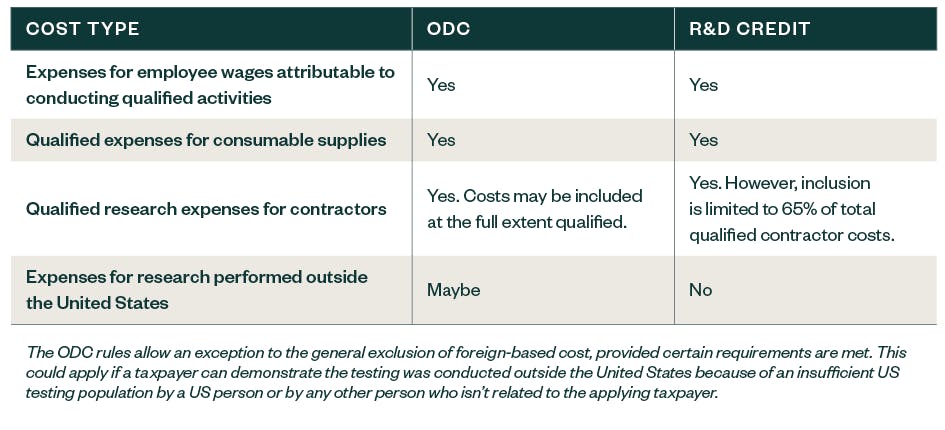
Another important distinction between orphan drug CTE and R&D QRE lies in the applicable qualification rates for contractor costs. The ODC allows for 100% of qualified contractor spending to be included as CTE, while the R&D credit caps the amount of costs includible as QRE at 65%.
Typically, eligible pharmaceutical companies see a higher rate of return on their orphan drug clinical testing expenses (CTE) compared to R&D credit qualified research expenses (QRE). While the federal gross R&D credit typically results in a tax credit of 10% of QRE, the ODC provides a rate of 25% of CTE.
Another important distinction between orphan drug CTE and R&D QRE lies in the applicable qualification rates for contractor costs. The ODC allows for 100% of qualified contractor spending to be included as CTE, while the R&D credit caps the amount of costs includible as QRE at 65%.
What do the orphan drug and R&D credits apply to?
Qualification for the orphan drug and R&D credits depends on the underlying activities performed and the resulting spending over the course of the development year. This will include costs for wage, supply, and contract research expenses.


Related sections

Order Level Material (OLMs): understanding GSA’s latest tool to optimizing schedule purchases
The information provided here is of a general nature and is not intended to address the specific circumstances of any individual or entity. In specific circumstances, the services of a professional should be sought. Tax information, if any, contained in this communication was not intended or written to be used by any person for the purpose of avoiding penalties, nor should such information be construed as an opinion upon which any person may rely. The intended recipients of this communication and any attachments are not subject to any limitation on the disclosure of the tax treatment or tax structure of any transaction or matter that is the subject of this communication and any attachments.