Article
Payroll tax considerations for remote workers and a checklist to mitigate risk
Dec. 13, 2020 · Authored by Matthew McKittrick, Chris Parker
The COVID-19 pandemic has increased remote work arrangements and dramatically altered work sites and offices. Some of those new arrangements may include employees working in states where the employer hasn’t previously conducted business or had a taxable presence.
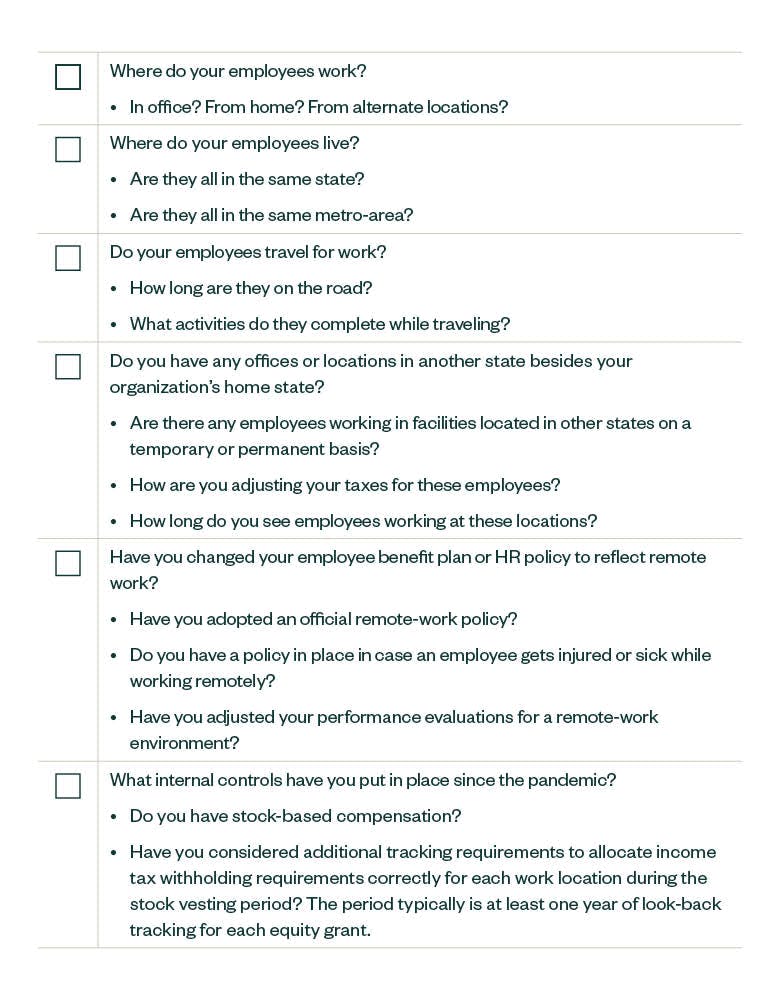
If your employees are working from other states — or even other countries — there could be a number of issues your organization needs to address to comply with the jurisdiction’s payroll tax laws. For example, most states require employers to withhold individual income taxes on wages paid to employees based on where that employee is working.
Below, learn how to better navigate payroll tax considerations if your organization has employees working outside the states where your business is registered or in a state where the business hasn’t had previous activity.
Income tax withholding
Income tax withholding is generally required to be reported in the state where the employee is performing services. As a result, it’s important to track where your employees are performing their work — especially if they’re moving from state-to-state.
Income tax that is withheld from wages paid for work done in a particular state must then be remitted to the state — typically by registering and filing periodic withholding reports with the state’s department of revenue. At the end of the year, the employee will file individual income tax returns to reconcile these withholding payments based on their specific tax situation.
Income tax withholding generally is required on all compensation or wages paid to an employee including stock-based compensation such as restricted stock units or nonqualified options. Typically, when the employee takes possession of the shares at the vesting or exercise date, the income paid at that event will require income tax withholding.
The income tax withholding should consider where the employee worked during the vesting period, which can span a year or more for typical equity-based compensation plans. As more employees elect to move to different or remote-work jurisdictions during the pandemic, a company should establish an effective way of tracking employees’ remote locations and the amount of time worked in each location during the vesting period. This income tax withholding should be allocated based on the amount of time worked in office versus remote locations subject to regulatory rules.
Exceptions


The information provided here is of a general nature and is not intended to address the specific circumstances of any individual or entity. In specific circumstances, the services of a professional should be sought. Tax information, if any, contained in this communication was not intended or written to be used by any person for the purpose of avoiding penalties, nor should such information be construed as an opinion upon which any person may rely. The intended recipients of this communication and any attachments are not subject to any limitation on the disclosure of the tax treatment or tax structure of any transaction or matter that is the subject of this communication and any attachments.