
Article
Personal goodwill in a sale can reduce tax liability
Oct. 9, 2012
Problem
The sale or distribution of assets in a corporate liquidation of a C corporation creates a corporate-level gain on which the corporation must pay the tax. The gain or loss at the entity level is the difference between the amount realized and each asset’s basis. Liquidating the corporation causes the shareholders to be taxed on the difference between the amount realized and their stock basis. This double taxation greatly increases the cost of the sale.
Solution
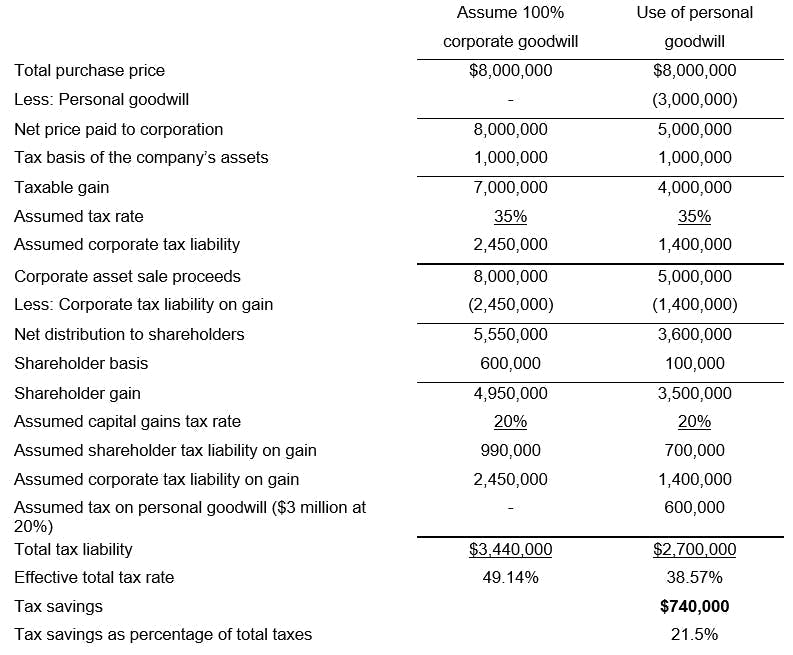
One approach to reducing this double taxation is to separate the intangible assets personally owned by the shareholders, known as the "personal goodwill," from those owned by the corporation. By separating the assets, the gain from the sale of assets can be divided between the corporation and the shareholders. By dividing the gain between assets owned by the corporation and assets owned by the shareholders, one level of tax can be avoided on the sale of the assets owned by the shareholders. This reduces the amount of gain realized at the corporate level, thereby reducing the total tax liability upon liquidating the corporation. Any gain on the sale of assets owned personally by the shareholders incurs only one level of tax—at individual capital gain rates. To the extent that goodwill exists in a corporate asset acquisition, a C shareholder may expect to retain about an additional 25 cents for every dollar of goodwill allocated to the individual rather than to the corporation. We have developed an example to demonstrate the benefits of using personal goodwill as a strategy to reduce a selling shareholder’s tax liability.
This strategy can even be helpful in an S corporation setting. For the first ten years of S corporation status, the built-in gain tax of Section 1374 imposes a corporate level tax on sales or disposition of assets at the maximum corporate rate. Personal goodwill would reduce the exposure to this built-in gain tax.
Background
In two landmark cases, Martin Ice Cream and Norwalk, corporate shareholders were able to separate personal goodwill from the assets owned by the corporation by proving that they generated personal goodwill that they owned and sold separately from the corporation.
Related sections
