Article
Top valuation trends for craft breweries in Q2 2020
June 17, 2020 · Authored by Derek A. Groff
In early 2020 the COVID-19 pandemic reached the United States, and government-issued stay at home orders decimated brewery taproom sales. While alcohol sales increased in the U.S. during the pandemic, breweries without established distribution channels are left to improvise new ways to get their product to the market.
Local breweries who had been focused on higher-margin taproom sales with little-to-no distribution have shifted towards to-go orders of crowlers and growlers. However, revenue generated from to-go sales is a fraction of pre-COVID-19 taproom sales. The long-term impact of the pandemic is uncertain.
Brewery taproom sales will likely feel the impact of government restrictions and safety guidelines throughout 2020. As states have started allowing taprooms to loosen up previous restrictions, capacity limitations will likely continue to damper brewery taproom sales.
Several factors present reasons for breweries and the industry overall to be cautious looking forward. To be successful in 2020, breweries will need to continue finding creative ways to bring their products to market while protecting the safety of their customers. Below, we explore notable trends for craft brewery valuations during the second quarter (Q2) of 2020 and their impact on the industry.
Market overview
Large brewers
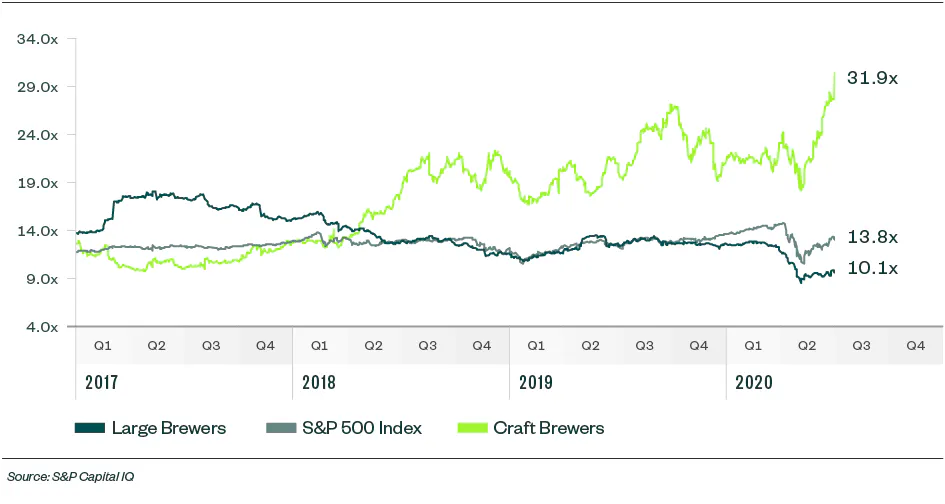
Large brewers are generally trading below the S&P 500 index, reaching a trailing earnings before interest, taxes, depreciation, and amortization (EBITDA) multiple of 10.1 times, compared to a multiple of 13.8 times, while publicly traded craft brewers are at a multiple of 31.9 times. The few remaining publicly traded craft brewers still experienced higher valuation multiples due to their substantial anticipated growth, which is driven by strong resonance with younger consumers.
The craft brewers segment was led by The Boston Beer Company (SAM). SAM recently acquired Dogfish Head and diversified into hard seltzers with the Truly brand. SAM is forecasting strong growth in the coming years, which is driving their high valuation.
SAM’s level of diversification and established distribution channels separate it from local breweries that rely on taproom sales. However, it provides a good indication of value for breweries with strong distribution.
Public market evaluations (multiple of enterprise value to EBITDA)


Understanding fixed income investments
The information provided here is of a general nature and is not intended to address the specific circumstances of any individual or entity. In specific circumstances, the services of a professional should be sought. Tax information, if any, contained in this communication was not intended or written to be used by any person for the purpose of avoiding penalties, nor should such information be construed as an opinion upon which any person may rely. The intended recipients of this communication and any attachments are not subject to any limitation on the disclosure of the tax treatment or tax structure of any transaction or matter that is the subject of this communication and any attachments.