Many businesses own or lease property and use real estate to meet their business goals. However, because real estate is a consequence of their business strategy and not their main business focus, many organizations lack the knowledge and resources to efficiently and effectively manage their real estate, construction, and property management portfolios.
Organizations considering a new approach to their real estate consulting strategies should consider the following:
Best practice considerations when formulating real estate plans
Construction project management tactics
New approaches to operational efficiency
Real estate consulting best practices
As a business grows or contracts, it may also switch between the different stages of real estate, including strategizing and planning, execution and implementation, and on-going management.
What are the stages of real estate?
There are a variety of tasks within each stage it’s important to be familiar with.
Strategizing and planning
Identify goals and objectives
Perform feasibility studies and due diligence
Define timelines
Identify funding sources
Review regulatory requirements
Perform construction planning
Identify opportunities
Review processes and controls
Execution and implementation
Maintain construction contract compliance
Assess cash flow and budgets
Review KPIs and develop reports
Analyze and optimize lease structure
Review and maintain contracts, lease agreements, and debt management
The information provided here is of a general nature and is not intended to address the specific circumstances of any individual or entity. In specific circumstances, the services of a professional should be sought. Tax information, if any, contained in this communication was not intended or written to be used by any person for the purpose of avoiding penalties, nor should such information be construed as an opinion upon which any person may rely. The intended recipients of this communication and any attachments are not subject to any limitation on the disclosure of the tax treatment or tax structure of any transaction or matter that is the subject of this communication and any attachments.
Advise on staffing considerations
Ongoing management
Identify appropriate transfer or exit options
Project turnover assistance
Oversee real estate valuation purchase and closing process
Evaluate tax structuring
Create post-closing strategy
Operations management
How do real estate and construction overlap?
Real estate and construction are very different industries, but they are also closely linked. The real estate industry acts most often as a supply chain for the construction industry. When the real estate market slows down, construction usually follows. To successfully manage the construction that real estate demands, it’s critical to have in-house or outsourced expertise to negotiate contracts with clear terms and controls, avoid cost overruns and project delays, monitor contract compliance, and report status and project financials accurately.
When to manage real estate or construction in-house or seek external help
Managing real estate or construction effectively comes down to three key points:
Skills
Experience
Bandwidth
If a team is strong in these areas, they can likely manage projects in-house. If not, outsourcing support may prove beneficial. Remember that an outside manager is only focused on their specific project and can’t be distracted by other internal business activities.
If the business' construction or real estate needs are few and far between, getting additional help only when needed instead of hiring a full-time employee may be most cost effective.
How to develop a capital plan and real estate strategy that complements business objectives
Growing businesses often address space needs without considering the impact of additional real estate on day-to-day operations. To develop a complimentary strategy, real estate expenditures should always be examined first. How much is rent each year? What are the company’s operating expenses and costs associated with capital improvements?
Next, utilization should be examined. If the company is renting a warehouse for storage, is the entire space in use? Are some locations performing better than others? Compare expenditures to that utilization versus the company’s financial goals. Are the numbers making sense? If not, it may be time to perform a portfolio facility audit to get a baseline read on the real estate portfolio, and compare it to stated business objectives.
Other questions to ask:
If the company is growing, are expansion suites available at current leased sites, or is it time to begin the process of finding undeveloped land to build on?
If reducing operations is forthcoming, what leases are expiring soon? Is subletting or selling more desirable?
Understanding the status of the company’s real estate holdings is essential before aligning any property strategy with other business objectives.
How to tailor a real estate portfolio to meet current and future business needs
Understand the company’s property portfolio before considering purchasing any new holdings. A facility assessment paired with a capital assessment is a sensible starting point for gaining such as a detailed understanding.
How to best plan for buying or selling
The inability to predict the future makes knowing when to sell or buy real estate difficult. To make the best-informed decision at any given time, stay current on capital planning, managing operating expenses, monitoring leasing schedules, and pay close attention to tax implications and the surrounding market.
By estimating future returns and weighing them against the company’s business goals and needs, analyzing opportunities to buy, sell, or hold will be clearer.
Major capital plan projects strategy
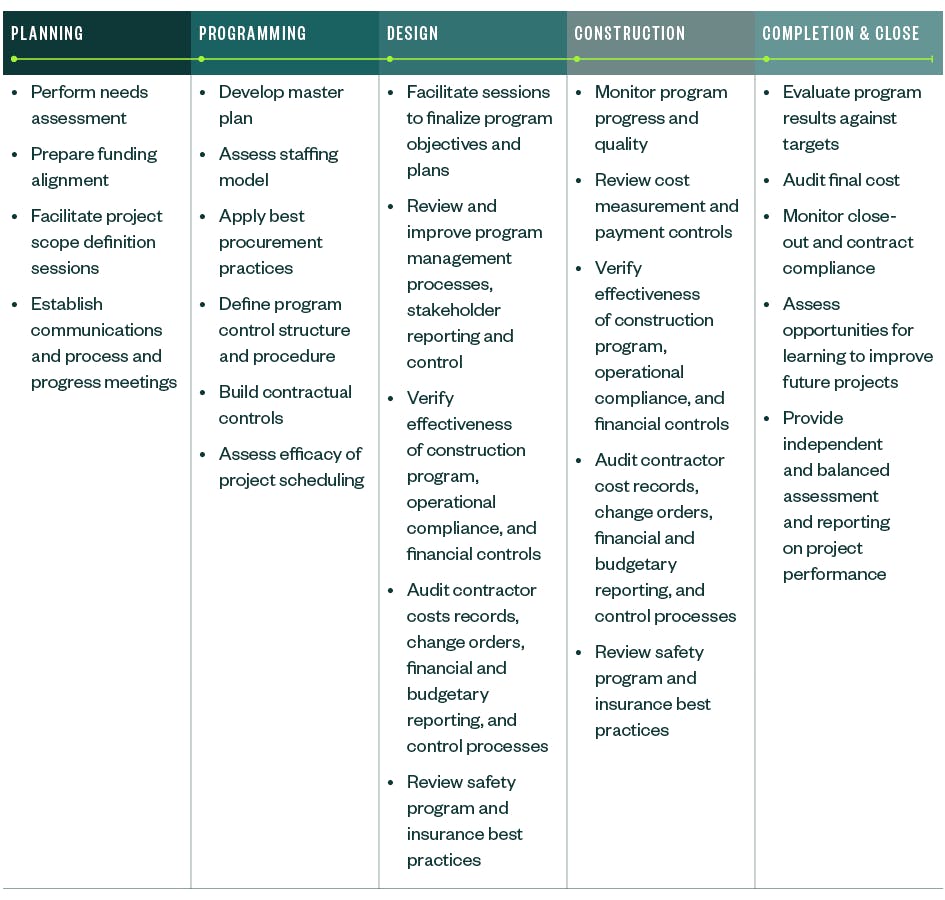
What are the phases of the project life cycle?
When is it best to perform assessments of a commercial construction project?
Early engagement and planning can prevent issues at later stages of the project. Some businesses prefer a hands-on approach and visit projects monthly, while others may prefer quarterly or even annual examinations.
What’s most important is that the frequency is re-examined with every project. Every project is unique and the need to audit may change given a project’s level of risk, its costs, scope, or stakeholders. This will highlight if an assessment should start at project inception, during performance, or at its close, and how often it should be repeated.
Teams, processes, policies, and contract types to execute on a commercial construction program
Ask these questions to determine if a new approach is needed:
Do property-related projects consistently finish with multiple change orders and cost overruns?
Are closeout packages missing essential documents?
Do payments get made with errors or insufficient backup such as missing lien releases?
If yes, re-examine how these projects are being executed. If a lack of expertise or bandwidth is identified, consulting with a construction advisor to review and recommend contract controls, perform an audit, or provide on-going monitoring may help improve future project results or recoup costs.
Facility and property management strategy
How to manage big budget contracts and capital plans for operating buildings
There are several considerations to make when planning annual budgets and capital plans.
Manage operational deliverables
Stay familiar with core contracts. Hold janitorial, parking, security, and engineering teams accountable for deliverables. Are they meeting with you as frequently as promised, and at the agreed-upon time?
Increase energy efficiency
Small steps like swapping out flushometers in building restrooms or switching to LEDs in common areas or big leaps like implementing full lighting control systems or collecting rainwater for reuse save resources and thus money.
Automate and centralize processes
Eliminate human error. Implement a robust, centralized document management system and automate processes whenever possible. Manually updated Excel templates saved to a colleague’s personal desktop can lead to missing deadlines or important dates.
Utilize data analytics to improve property management
Track how fast work orders are completed and whether access card timestamps reveal underused spaces. Note whether the security staff’s daily reports often include the same issues.
Monitor local news
Building Owners and Managers Association (BOMA), the Institute of Real Estate Management (IREM), and other professional associations might be a resource for tracking trends or laws.
Solicit feedback from tenants
Consider facilitating an annual performance survey to learn more about tenants and customer concerns.
Analyze metrics and leverage insights to improve property management
Look for opportunities to analyze data. Many companies gather data without realizing it, or ignore historical data.
Examples of valuable data include:
Activity reports from garages or elevators showing the busiest times of day
Security activity reports
Work order completion times
Work order types in a particular month
Tenant feedback surveys
Monitoring and analyzing this data can help predict maintenance costs, optimize rental rates, or predict tenant turnover, leading to cost savings and fewer vacancies. With info-driven data, stakeholders can make better, more informed decisions to drive operational efficiency and increase portfolio performance.