Article
Your essential checklist for mastering SOC 2 compliance
Sept. 6, 2021 · Updated June 26, 2025 · Authored by Jared James, Priya Kumar
Key takeaways
- Benefits of compliance. A SOC report helps your organization demonstrate robust internal controls, attract potential clients, and streamline vendor management.
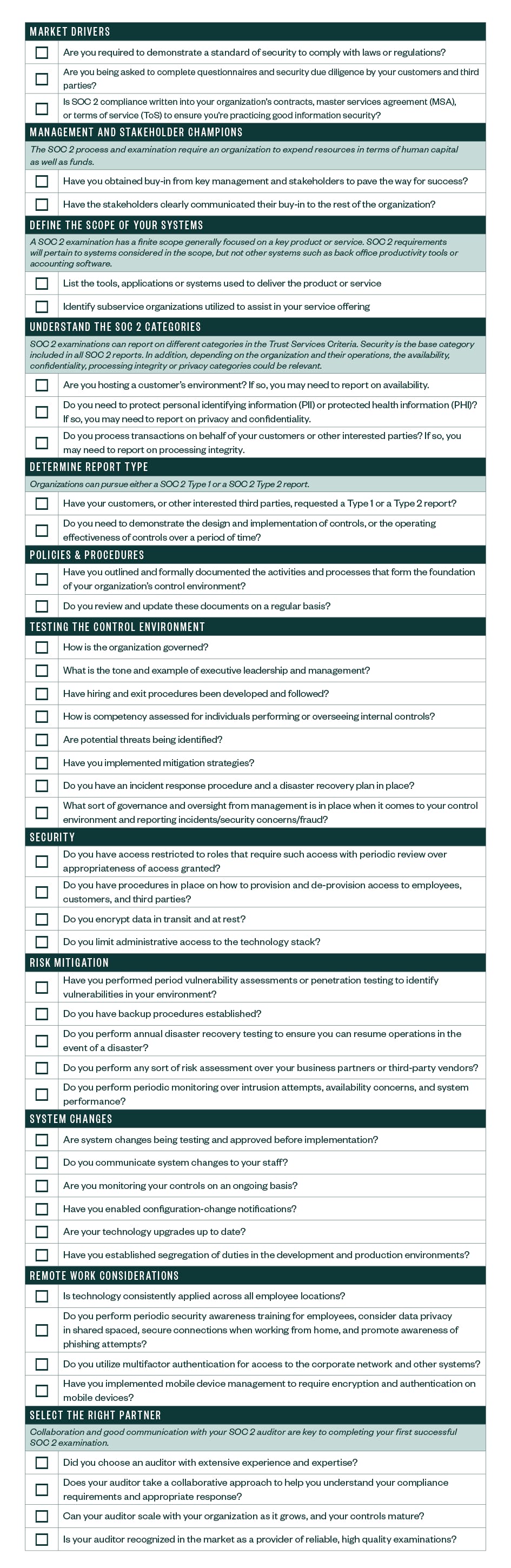
- Prepare for certification. Understand the type of SOC 2 report required and follow a structured checklist to maintain compliance and certification.
- Checklist highlights. Use our checklist to define the scope of your systems, determine the proper report type, test your control environment, and outline your risk mitigation.
Organizations that are new to SOC 2 certification and want to maintain compliance have a series of factors to consider.
This article is designed to help you first understand why SOC 2 reports are required or requested, and how your organization can prepare for and maintain its certification.
Why do you need a SOC 2 report?
SOC 2 examinations, also known as SOC 2 audits, have become an expected standard for all service organizations that interact with, or operate as, vendors or service providers that store, process, or maintain client data. CISOs, CFOs, and auditors rely on SOC 2 reports to gain comfort and valuable insight over the internal controls of critical vendors and service providers.
Regardless of your company’s line of services — from Software as a Service (SaaS) to Intelligent Autonomous Systems (IAS) — if it has ongoing interactions with customer data or third-party providers, it likely needs an annual SOC 2 report to remain competitive in the marketplace and to forego the numerous vendor audit and security questionnaires.
Consistent SOC 2 audits not only help keep your company safe, but they can also help potential customers, business partners, or buyers gain comfort over the soundness of the system of internal controls. This can help your company’s credibility and competitive edge in the market and can increase consumer confidence.