
Article
Tax planning FAQs for U.S. beneficiaries of foreign trusts
July 25, 2022 · Authored by Brittain Cunningham, Stuart Myhill
U.S. citizens or residents who are beneficiaries of foreign trusts must follow complex tax reporting requirements. Below are answers to frequently asked questions on the topic of U.S. taxation of foreign trusts.
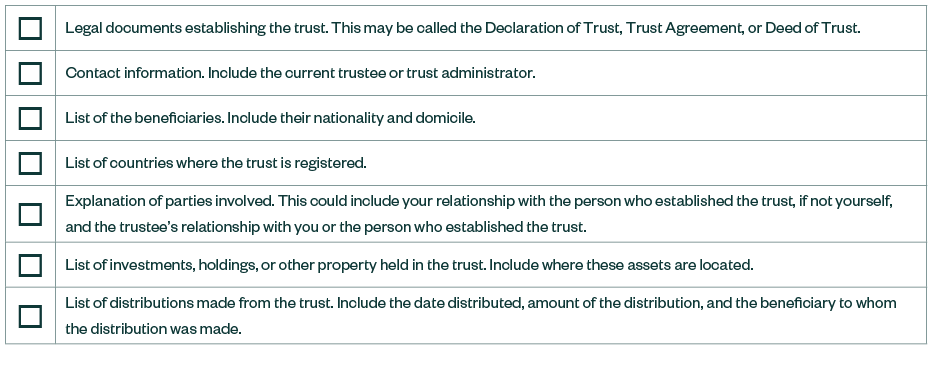
What information will your tax advisor need?
You should seek the assistance of a qualified U.S. tax advisor who has experience advising U.S. beneficiaries of foreign trusts. Before meeting with your advisor, you should collect some key information that will help your advisor evaluate your unique facts as noted below.
Can this legal arrangement be considered a foreign trust for U.S. tax purposes?
Your advisor can help you determine if the legal arrangement in question should be treated as a trust for U.S. tax purposes, which isn’t always straightforward considering how different countries may interpret the definition of a trust. These foreign legal arrangements must be evaluated under the parameters of the U.S. definition of a trust. Classifying the trust as either a U.S. or foreign trust is essential for determining the proper reporting required.
Once you’ve determined that the legal arrangement is a trust for U.S. tax purposes, the next step is to consider whether the trust should be considered a domestic or foreign trust.
If a trust fails one of two tests — the court test and the control test — it’s considered a foreign trust. These tests are solely a construction of U.S. law and are independent of any foreign classification of a trust.
Court test
The court test looks to whether the trust is legally established or registered in the United States.
Control test


The information provided here is of a general nature and is not intended to address the specific circumstances of any individual or entity. In specific circumstances, the services of a professional should be sought. Tax information, if any, contained in this communication was not intended or written to be used by any person for the purpose of avoiding penalties, nor should such information be construed as an opinion upon which any person may rely. The intended recipients of this communication and any attachments are not subject to any limitation on the disclosure of the tax treatment or tax structure of any transaction or matter that is the subject of this communication and any attachments.