
Article
Prepare for third-party risk management challenges
Feb. 15, 2022 · Authored by Jason Emmons, Jennifer Grant, Evan Higashiyama
Risk and compliance professionals face an ever-changing landscape of challenges with the rise of software-as-a-service (SaaS) outsourcing. These risk-management professionals are expected to protect their stakeholders while their organizations outsource parts of the value chain in ways that may not represent their core competency.
Refining an organization’s approach to third-party risk management could reduce stress on the risk management department and protect your organization from future breaches.
Why do companies outsource to SaaS solutions?
Companies might choose to delegate operations or other job functions for many reasons, though it’s typically to overcome budget, skill, or resource limitations.
Third-party service providers help companies to scale operations, gain expertise, and even improve the end-user experience without having to invest in costly new technologies or hire new staff.
SaaS outsourcing security risks
SaaS solutions can solve some common business problems, but third-party vendors may be prone to implementing one-size-fits-all approaches that can make them unable to adapt to quickly evolving needs.
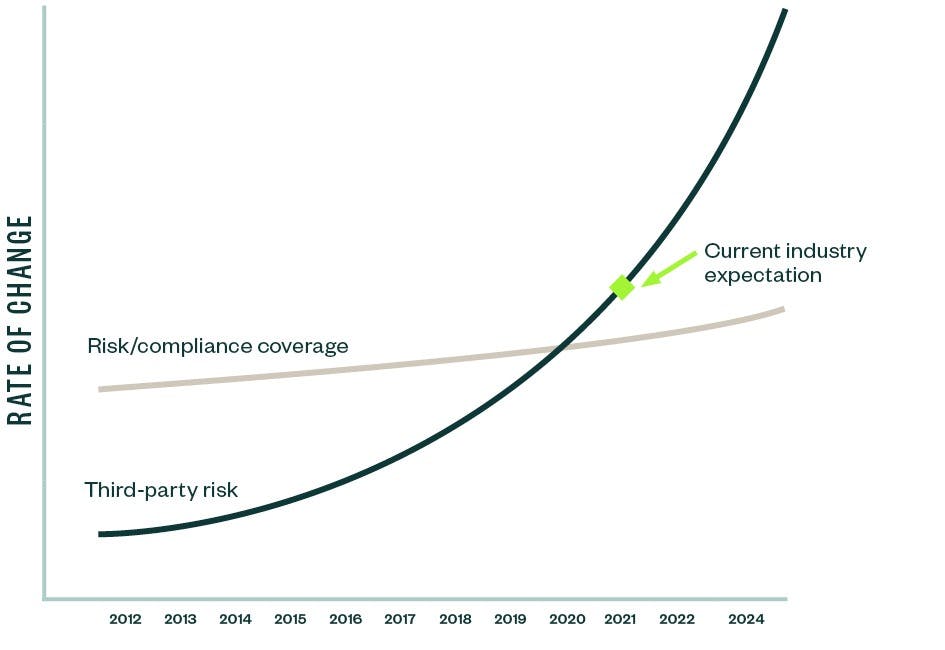
Beyond simple operational inconveniences, there can be real risks that come with outsourcing IT solutions as well. The following graph illustrates the disparity between third-party risk and risk compliance.
Risk management versus technological advancement
Causes of third-party risks
With rapid changes in technology, digitization, and global connectivity, risk management professionals must often scramble to keep up with the rate of change.
Business decisions can happen faster than risk management professionals can anticipate, such as opting for a SaaS solution with less stringent risk management practices — a pivot that can put the organization and its data at risk.
