
Article | 2025 year-end tax planning
2025 Year-end planning considerations for individual taxpayers
Nov. 13, 2025 · Authored by Andrew Whitehair
While the One Big Beautiful Bill Act (OBBBA) (P.L. 119-21) brought many changes and some surprises for individual taxpayers, perhaps more significant were the things it did not change. Numerous provisions implemented by the 2017 Tax Cuts and Jobs Act (TCJA) were set to expire at the end of 2025. Not only did OBBBA prevent most of these provisions from sunsetting, but it also extended many permanently. We’ll review the profound impact these “non-changes” have on individual taxpayers as well as the new tax provisions OBBBA introduced. Although tax legislation certainly dominated this year’s tax news, we will also cover a few other items of note.
One Big Beautiful Bill Act
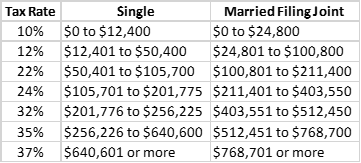
Tax rates: Following OBBBA, the lower tax rates and higher bracket thresholds TCJA introduced are now permanent, averting a tax increase for most individuals. Furthermore, despite some discussion early in the year, OBBBA did not include a millionaires’ tax or increase in the marginal rate (more on this later). 2026 tax rates and brackets are as follows:
Miscellaneous 2% expenses: OBBBA makes permanent TCJA’s elimination of miscellaneous 2% expenses.
Planning: Continue to look for opportunities to convert nondeductible investment expenses into deductible expenses such as using a lender management structure for family offices.
Enhanced standard deduction/personal exemption elimination: OBBBA makes permanent the larger TCJA standard deduction and permanently eliminates personal exemptions. The standard deduction for 2026 is $32,200 (married filing jointly (MFJ)), $24,150 (head of household (HOH)) and $16,100 (other filers).
Observation: After TCJA increased the standard deduction, fewer taxpayers itemize their deductions. Although OBBBA keeps the enhanced standard deduction, the increased state and local tax (SALT) cap will likely lead more taxpayers to itemize in 2025 and 2026 than in previous years.
199A Qualified business income deduction: OBBBA made this deduction for owners of pass-through businesses permanent and kept the deduction percentage at 20%. The wage/investment limitation calculation was changed slightly to be more beneficial for owners of specified service trade or businesses (SSTBs), but at higher incomes, SSTB owners will still lose this deduction.
Excess business losses: OBBBA made the excess business loss limitation permanent. It also reset the inflation adjustment base year to 2024, which reduces the allowable loss deduction to $256,000 ($512,000 if married) for the 2026 tax year.
Alternative minimum tax (AMT): OBBBA made permanent the TCJA AMT exemption amount but reverts the exemption phaseout thresholds to 2018 levels of $1 million (MFJ) and $500,000 (other filers) in 2026 and indexes the amount for inflation thereafter. Furthermore, the AMT exemption phaseout increases from 25% to 50%, resulting in faster use of exemption. The reversion of the phaseout thresholds and change in the phaseout rate will likely subject some additional high-income taxpayers to AMT in 2026.
Planning: Resolves the uncertainty regarding the possible return of AMT, which could impact taxpayers holding incentive stock options (ISOs) or shares from an ISO exercise.
Qualified mortgage interest deduction limitation: OBBBA made permanent the $750,000 ($375,000 MFS) limit on qualified mortgage interest and permanently eliminated the deduction for home equity interest.
Casualty losses: OBBBA made permanent the TCJA limitation on deductions for personal casualty losses, but it added an exception for state-declared disasters.
Consider: Although TCJA eliminated deductions for most personal casualty losses, taxpayers can still claim personal losses for certain disasters, Ponzi schemes, and other losses on transactions entered into for profit (see CCA 202511015).
Enhanced child tax credit (CTC): OBBBA permanently increases the nonrefundable CTC to $2,200 starting with tax year 2025 and indexes the amount for inflation for tax years after 2025. TCJA’s CTC phaseouts of $200,000/$400,000 (single/MFJ respectively) are made permanent, but the legislation does not index them for inflation.
Itemized deduction limitation: OBBBA made the TCJA repeal of the Pease limitation permanent, but it introduced a new overall limit on itemized deductions applicable to those in the top 37% tax bracket for tax year 2026 and beyond. The new limit cuts the tax benefit from itemized deductions by 2% (effectively capping the tax benefit from itemized deductions at 35%).
Planning: High-net-worth taxpayers expecting to be subject to this limitation in 2026 should consider accelerating itemized deductions, such as charitable contributions, into 2025.
Several new charitable contribution provisions
Charitable contribution floor: OBBBA introduced a new limit on charitable contributions that applies to all itemizing taxpayers. For tax years after 2025, charitable deductions are subject to a new floor equal to 0.5% of adjusted gross income (AGI). Only charitable deductions in excess of the 0.5% floor are deductible. For example, a taxpayer with $200,000 of AGI will be unable to deduct the first $1,000 of charitable contributions.
Planning: Especially in context of the overall itemized deduction limitation, this provision further reduces the tax benefit from charitable contributions. Taxpayers should consider accelerating charitable deductions into 2025. Additionally, if a taxpayer has an excess charitable carryover, the amount limited by the charitable floor also carries over to the subsequent year. As a result, taxpayers close to generating an excess charitable carryover should consider contributing just enough to put them into an excess position in order to preserve the floor limited amount for future years.
60% AGI limitation: OBBBA made the 60% AGI limitation for cash contributions to public charities permanent.
Charitable deduction for non-itemizers: Starting in 2026, taxpayers who do not itemize can deduct up to $1,000 ($2,000 for joint returns) of cash contributions made to public charities each year. The following gifts are not eligible: 1) noncash gifts (such as clothing or household goods), 2) gifts to section 509(a)(3) supporting organizations and 3) gifts to donor advised funds (DAFs). Additionally, charitable carryovers from prior years are not eligible to be deducted under this non-itemizing provision. This new below-the-line deduction for non-itemizers is permanent.
Further reading: For more charitable planning advice including other strategies such as bunching, using charitable trusts, and gifting appreciated assets, check out the following article: Three case studies to illustrate the new One Big Beautiful Bill Act charitable tax provisions.
State and local tax deductions: TCJA limitations on state and local tax deductions remain, but OBBBA increases the deduction to $20,000 (MFS) and $40,000 (all other filers). The deduction phases down for taxpayers with modified AGIs (MAGIs) exceeding $250,000 (MFS) and $500,000 (all other filers) but not below $5,000 (MFS) or $10,000 (all other filers). Starting in 2026, the deduction cap and phase-down threshold will increase 1% annually through 2029 before reverting back to the $10,000 TCJA cap.
Planning: Consider whether a taxpayer would benefit from prepayment of state and local tax payments before year-end 2025. Taxpayers in the phaseout range ($500,000 to $600,000 for most filers) will see an increase in their effective tax rate of 30%, due to the loss of their SALT deduction. Consider whether managing a taxpayer’s income to keep below this punitive phaseout makes sense.
Pass through entity tax (PTET): The final legislation includes no changes to PTET workarounds. Subject to state availability and conformity, business owners can continue to avail themselves of PTET regimes, which allows some business owners to avoid application of the SALT cap on state income taxes paid directly by their business entity.
Enhanced senior citizen deduction: Taxpayers who have reached age 65 in tax years 2025 through 2028 receive an additional $6,000 “temporary senior deduction,” which is phased out at MAGIs over $150,000 (MFJ) and $75,000 (other filers). The amount is allowed for itemizers and non-itemizers and is not indexed for inflation.
Consider: Social security benefits remain taxable, but this provision was introduced as a partial fulfillment of President Trump’s campaign pledge to eliminate taxes on social security. This deduction is also on top of a senior’s standard deduction and the additional standard deduction available to taxpayers over the age of 65.
Qualified small business stock: OBBBA increases the per-issuer gain exclusion cap to $15 million for stock acquired and the gross assets ceiling to $75 million for stock issued after the July 4, 2025, enactment date. Starting in 2027, these amounts will be adjusted for inflation. OBBBA also introduced a graduated exclusion holding period with 50% exclusion after three years, 75% after four years, and 100% after five or more years.
Planning: Carefully consider choice of business entity for startups.
Tax credits for contributions to scholarship granting organizations: An annual tax credit of $1,700 is available starting in tax year 2027 for contributions of cash to scholarship granting organizations (SGOs). SGOs are tax-exempt organizations for which substantially all activities provide scholarships for qualified elementary and secondary expenses of eligible students. No charitable deduction is allowed for amounts claimed as a credit.
529 plans: OBBBA expanded eligible K-12 education expenses to include curriculum materials, books, online materials, tutoring, standardized testing fees, higher education dual enrollment expenses, and educational therapies for students with disabilities. Additionally, the annual amount of elementary and secondary expenses eligible to be paid from a 529 plan increases to $20,000 per beneficiary starting in 2026. Certain qualified postsecondary credentialling expenses (e.g., CPA exam fees or licensing fees) are also added to the list of eligible 529 expenses.
Note: The new categories of eligible expenses took effect upon enactment on July 4, 2025, so they could yield a 2025 benefit.
Trump child accounts: A new tax-favored account similar to a nondeductible IRA is created for U.S. citizens under age 18. The federal government will contribute $1,000 to such account for every U.S. citizen born during 2025 through 2028. Additionally, contributions of up to $5,000 (inflation adjusted) per year can be made from birth through age 17, with no distributions allowed until age 18. Distributions are subject to the rules applicable to traditional IRAs. Investment options are limited to U.S. equity index investments with expense ratios not exceeding 0.1%. The law also provides for an employer exclusion for contributions up to $2,500 (inflation adjusted). Distributions can be taken under the normal traditional IRA rules with limited pre-59 ½ distributions allowed for qualified college expenses and first-time home purchases. Contributions are returned tax-free, but income would be taxed at ordinary rates with penalties for nonqualified distributions. Under OBBBA, the earliest these accounts can be available to accept contributions is July 4, 2026.
Planning: Trump accounts give families the opportunity to give their children a substantial head start on retirement saving. However, for many parents, 529 plans remain a superior choice among tax-favored savings vehicles.
Deductible car loan interest: For tax years 2025 through 2028, OBBBA allows a deduction for up to $10,000 of new car loan interest on U.S. assembled vehicles. Only new car loans taken out or refinanced (if it doesn’t add to the balance of the original loan) in 2025 through 2028 are eligible. The deduction phases out for MAGIs exceeding $200,000 (MFJ) and $100,000 (other filers) (fully eliminated at $250,000 (MFJ) and $150,000 (other filers)). This deduction is available for non-itemizers.
Tips deduction: OBBBA establishes a new below-the-line deduction through 2028 for qualified tip income. Taxpayers may deduct up to $25,000 of qualified tip income, subject to a phaseout for individuals whose MAGI exceeds $150,000 ($300,000 for joint filers). Tips must be voluntary, nonnegotiated and paid by the patron and can be paid by cash or charged. Taxpayers in occupations that customarily and regularly receive tips prior to 2025 are eligible for the tip exclusion. On Sept. 22, 2025, the IRS issued proposed regulations that include a list of eligible occupations. Federal employment taxes and possibly state and local income taxes still apply to excluded tip income.
Overtime deduction: OBBBA establishes a new below-the-line deduction through 2028 for qualified overtime (OT) income. Taxpayers may deduct up to $12,500 of qualified overtime income ($25,000 for joint filers). There is a phase-out component for individuals whose MAGI exceeds $150,000 ($300,000 for joint filers). For overtime deductions, employees must receive OT pay as defined by the Fair Labor Standards Act (i.e., pay for hours worked beyond 40 in a regular work week). Note that the deduction only applies to the amount paid in excess of their regular hourly rate.
In March, President Trump signed Executive Order 14247 requiring all federal disbursements and receipts — including tax payments and refunds — to be made electronically. The order mandates that the IRS stop issuing paper refund checks as of Sept. 30, 2025. However, there is no specified deadline for taxpayers to make electronic tax payments.
Various taxpayers are currently unable to comply with this order and will require an exception to the order or will need Treasury to provide alternative payment options, including but not limited to the following:
- International taxpayers limited by banking regulations from making ACH deposits and withdrawals through the U.S. banking system to or from their foreign bank accounts
- Taxpayers (such as foreign nationals) who do not have an ITIN or SSN and thus are unable to use electronic payment systems.
- Trusts and estates currently do not have an option for direct deposit.
To the extent taxpayers are able to comply with this order, they should do so as soon as practical. For example, trust taxpayers should establish an electric federal tax payment system (EFTPS) account (trusts are unable to use IRS Direct Pay) as soon as possible, as the process can take several weeks. Individuals should be encouraged to adopt one of the various means of making electronic payments listed on the IRS website.
For taxpayers unable to comply (whether that is due to IRS system limitations, other laws and/or regulations, etc.), they should proceed to file and pay their tax obligations under existing methods and await further Treasury guidance.
The IRS continues to have success recharacterizing ordinary income allocable from state-law limited partnerships as subject to self-employment tax. In Sorobon (T.C. Memo 2025-52) and Denham (T.C. Memo 2024-114), the Tax Court applied a functional analysis test that examined the roles and responsibilities of the limited partners. In both cases, the court found that the limited partner exception to self-employment taxes did not apply because the partners “were limited partners in name only.” The partners in these cases participated in the day-to-day management of the business. They acted more like employees than passive investors, hence the applicability of self-employment tax. This is an evolving area of tax law that those in the fund management business should pay careful attention to going forward.
In September, Congressional Democrats reintroduced the Billionaires Income Tax Act which aims to institute a wealth tax on the nation’s billionaires. Essentially, the act will require applicable individuals (those who meet certain AGI and asset tests) to mark-to-market tradeable assets annually, pay an interest charge on tax deferral for nontradeable assets, and recognize gain on gifts and bequests. The proposal would also eliminate many popular deferral strategies available to high-net-worth taxpayers including qualified small business stock, qualified opportunity zones, and 1031 exchanges. Although there is nearly zero chance this proposal advances in the current Congressional environment, it is one example of a trend of tax proposals targeting the nation’s wealthiest.
At the beginning of 2025, President Trump and some Republicans floated the idea of a millionaires’ tax. There were a few options discussed, including a new 40% top rate on individuals earning over $1 million or reinstituting the 39.6% top rate for individuals earning over $2.5 million. Neither option was included in OBBBA.
Although it is unlikely we will see any federal action on this topic, it is possible one or more states implement a tax targeting the wealthy. In October, a proposal (the “2026 Billionaires Tax Act”) to place a wealth tax on California resident billionaires was submitted. If the proposal qualifies, it could be placed on the November 2026 California ballot. In Washington state, historically a state without an income tax, legislators are considering introducing a 9.9% income tax on incomes over $1 million. Additionally, in New York City, mayor-elect Zohran Mamdani seeks a 2% surcharge on city residents earning over $1 million annually.
If you have questions on how the above information may impact your tax situation, please contact your Baker Tilly tax advisor.

Related sections
Article Tags
