Article
How auditors use GRC tools and why your audit process needs both
July 3, 2025 · Authored by Chris Kradjan
If your organization is using a governance, risk, and compliance (GRC) tool, you’ll see the greatest efficiency and impact when your audit team understands how to work within that platform.
Requirements like SOC 2, HIPAA, and FedRAMP demand significant documentation and control validation — tasks GRC tools can help streamline through automation and centralized data. Pairing that technology with an auditor who’s familiar with the tool’s workflows can reduce friction, improve accuracy, and help your team move through compliance faster.
Discover how combining GRC tools with a knowledgeable auditor can elevate your audit compliance management processes with the following insights.
GRC tools simplify the audit process
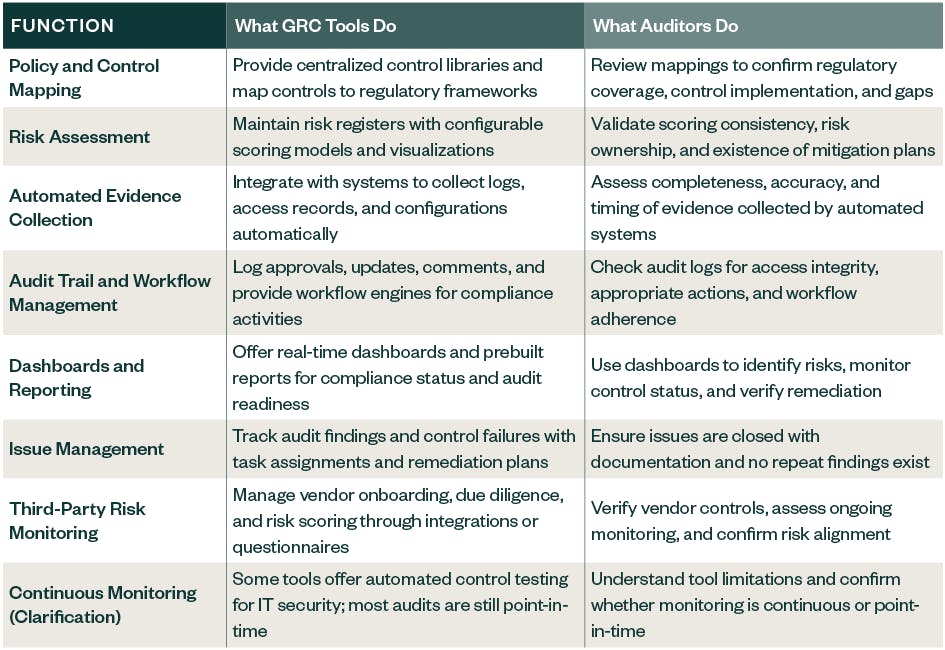
Compliance auditors evaluate whether an organization meets internal policies, regulatory requirements, such as the Sarbanes-Oxley Act of 2002 (SOX), HIPAA, or GDPR, and industry standards like ISO 27001 or NIST. GRC tools support this work by centralizing control libraries, streamlining evidence collection, and standardizing workflows and documentation.
Working with an auditor who understands how to align with and leverage GRC platforms can help streamline the audit process. This collaboration enables real-time visibility into security controls, supports proactive risk management, and facilitates timely remediation.
In addition to providing data to your auditor, there are also benefits for your organization. A GRC tool can enhance your ability to self-assess, organize documentation, and curate evidence.