If you have a transaction on the horizon — or you want to be prepared in the event that one presents itself — there are strategies and checklists across multiple areas of your business and personal finances that could make your business more attractive for a potential buyer.
Some of these benefit from being reviewed and monitored throughout your company’s life-cycle, which gives you time to make adjusts as needed:
Executive retention
Cybersecurity
State and local tax liability
Here are three others to include on your pre-transaction list:
Due diligence
Personal financial plan
Post-transaction integration
Unique M&A landscape
Technology, communications and media, and life sciences sectors have become the focus of mergers and acquisitions activity as they continue to attract more capital, even from suitors that have historically not paid attention to these sectors.
Transactions aren’t predicable anymore — an offer could happen tomorrow. While this could work to your benefit, it does create a more frantic mergers and acquisitions environment. The key is to prepare early so you’re ready when someone shows interest.
Ongoing assessments
Things move quickly once a transaction is in the works. With cybersecurity and tax efficiency, it’s best to assess your risk and liability, respectively, so you can make improvements prior to a transaction. The same is true of executive retention.
1. Executive retention
In today’s environment, if you have financial buyers, they’re investing in the future of the business, but they don’t want to necessarily run the business. If you can incentivize the executives to stick around for the second generation of owners, you could help alleviate transaction risk.
There are additional benefits from spending the necessary time and money to improve employee retention rates. Executive retention in particular supports:
The information provided here is of a general nature and is not intended to address the specific circumstances of any individual or entity. In specific circumstances, the services of a professional should be sought. Tax information, if any, contained in this communication was not intended or written to be used by any person for the purpose of avoiding penalties, nor should such information be construed as an opinion upon which any person may rely. The intended recipients of this communication and any attachments are not subject to any limitation on the disclosure of the tax treatment or tax structure of any transaction or matter that is the subject of this communication and any attachments.
Preserves institutional knowledge
Prevents competitor poaching
Lowers recruiting and onboarding costs
Increases productivity
Equity compensation
Equity compensation is a popular strategy for companies to attract highly qualified candidates, boost employee engagement, and secure tax savings.
Many companies, optimistic about these benefits, start equity compensation programs without sufficient planning. They’re often surprised to discover the nuanced accounting requirements involved as well as the required operational systems for a program to run smoothly. Understanding the tax ramifications for both the business and the executives is essential to help avoid any hidden liabilities.
2. Cybersecurity
With the prevalence of data breaches — and their financial impact — cybersecurity takes on even greater importance for technology companies planning for an exit, such as an acquisition, merger, or IPO.
Companies of any size need to get smart, structured, and started on cybersecurity before acquisition talks begin. Doing so can help strengthen the value of assets being bought or sold, facilitate smoother negotiations, and keep reputation or regulatory threats from causing damage before the deal is done.
IT audit
An IT audit can provide opportunities to fine tune your operational systems and help all functions are running smoothly. It’s also a good time to consider application security planning to protect against risks introduced by third-party vendors.
While IT and internal audit teams share a common goal of protecting an organization against risks, collaboration between the teams can sometimes cause friction due to key differences in approach and language. Understanding how these teams interact, and some of the common collaboration challenges they face, can help facilitate stronger cybersecurity defenses for your company.
Additional insight
What you need to know about cybersecurity before starting due diligence
Help reduce cyber-risk through better departmental collaboration
3. Tax efficiency
Assessing your business’ structure can help you identify possible modifications to increase its future value. Here are some outcomes:
Introduce alterations in management
Improve processes through new technology
Enhance current entity structure
These changes can help initiate a tax-efficient sale or transition of the business, with a specific focus on the tax changes introduced through tax reform.
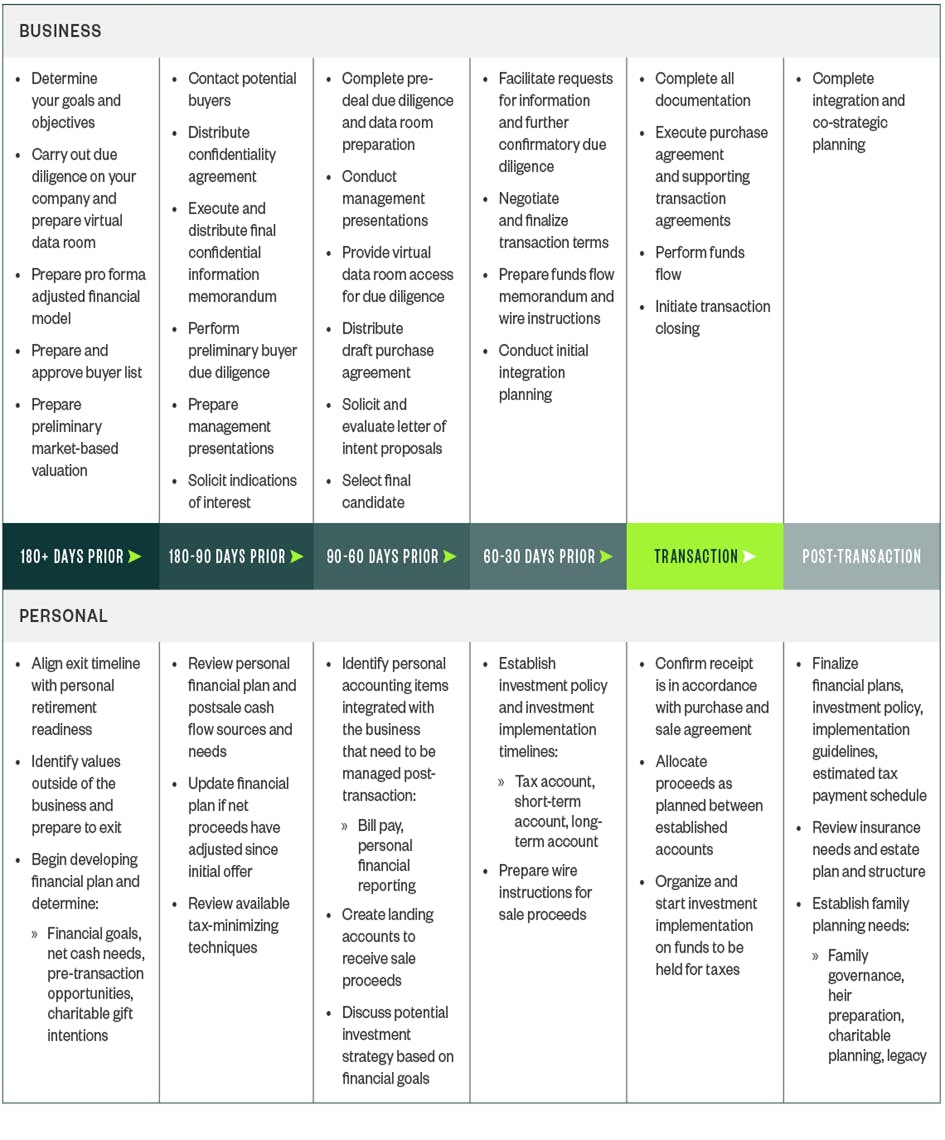
To get you started, here’s a pre-transaction checklist for your business and personal needs. While this can serve as a starting point and doesn’t take specific scenarios into account, you can see it’s already quite extensive.
Pre-transaction checklist
4. Due diligence
Pre-transaction due diligence and sell-side quality of earnings prepares your company for the transaction process and improves the conditions of a sale.
Before you go to market, consider answering the following questions as part of a transaction preparedness evaluation. This process can provide you with confidence in your position and help you avoid surprises during the transaction process.
Foundational questions
Have you set up a virtual data room organized to address key buyer due diligence issues?
Have you prepared a quality of earnings report, review, or audit?
Have you identified pro forma adjustments to your financial statements for nonrecurring items?
Are internal financial statements up-to-date?
Have you identified non-GAAP accounting policies?
Do you know key risk areas present within your company?
Does your company have significant, uncertain tax positions a buyer could identify?
It’s critical that your chosen transition plan aligns with your overall estate objectives, your personal objectives, the business financial plans, and your after-tax cash flow and liquidity needs.
A personal financial plan models your personal balance sheet, considers your business goals, and calculates how your personal wealth allocation may change over time. This process can be as important as the end product because it allows business owners to identify their goals and create a timeline to achieve them.
Additionally, an estate plan that’s in alignment with your personal financial plan and business plan can help resolve unique family issues, fairness, equality considerations, life-time cash flow needs, and enhancement of after-tax wealth transfer and asset protection.
These combined components help you understand the net amount you need to receive from selling your business to achieve your desired future lifestyle, as well as put numbers to your estate plan and business value.
To execute the transition plan you’ve laid out for your business, take time to consider any related complexities. One of the most important factors prior to transaction is orchestrating the successful postmerger integration of key processes and operations. This can help reduce disruption and realize your vision quickly and seamlessly.
On the business side, focus on completing integration and co-strategic planning. On the personal side, meanwhile, the to-do list can sometimes be more extensive:
Finalize financial plans, investment policy, implementation guidelines, and an estimated tax payment schedule
Review insurance needs and estate plan and structure
Establish family planning needs, which includes family governance, heir preparation, charitable planning, and your intended legacy