Article
An overview of clean energy tax legislation in the Inflation Reduction Act
Aug. 25, 2022 · Authored by Jon Blitman, Eric Rohner, Rob O'Neill, Matt Kaden
The Inflation Reduction Act of 2022 is the largest ever commitment made by the United States to fight climate change, in the form of almost $400 billion in tax incentives aimed at reducing carbon emissions and accelerating the country’s energy transition away from fossil fuels.
While companies associated with renewable energy will likely be the largest and most direct beneficiaries of the act’s incentives, companies in the fossil fuel sector also stand to benefit from several new and expanded incentives designed to cause a redeployment of capital toward decarbonization activities. Utilities will benefit from relaxation of normalization requirements for battery storage.
In many ways, the act, which was signed by President Joe Biden on Aug. 16, 2022, is a rebranding of the Build Back Better Act (BBBA), which passed in the House in 2021 before stalling in the Senate. The Inflation Reduction Act, however, differs in some key respects from BBBA.
Synopsis of Inflation Reduction Act’s clean energy changes
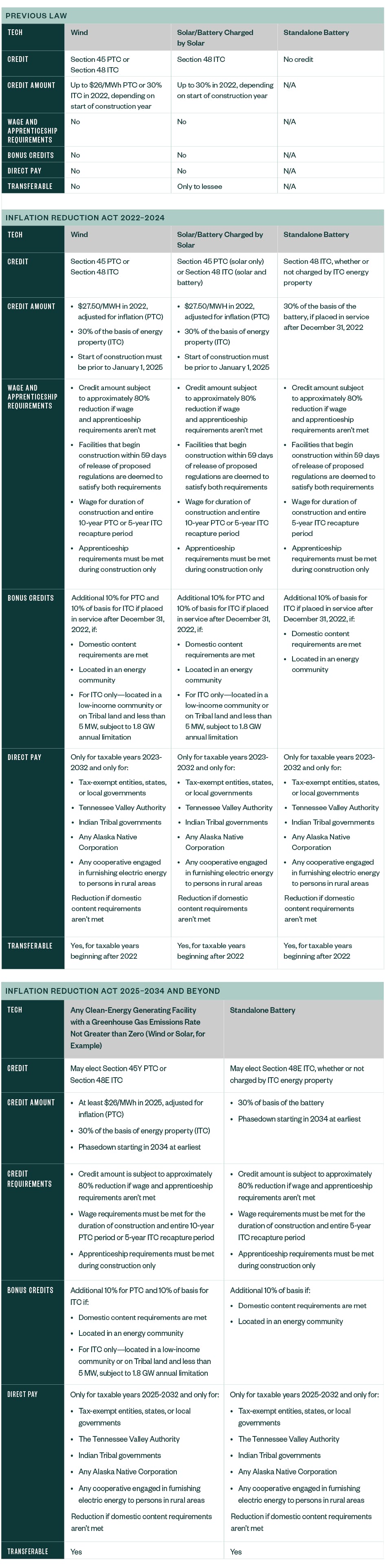
Like the BBBA, the Inflation Reduction Act generally extends existing incentives for clean energy at least at their highest rate. For example, the rate is $27.50 per megawatt hour (MWh) for the production tax credit (PTC) for projects placed in service in 2022, which is up from $26 per MWh pre-Inflation Reduction Act, and 30% of qualifying capital expenditure for the investment tax credit (ITC).
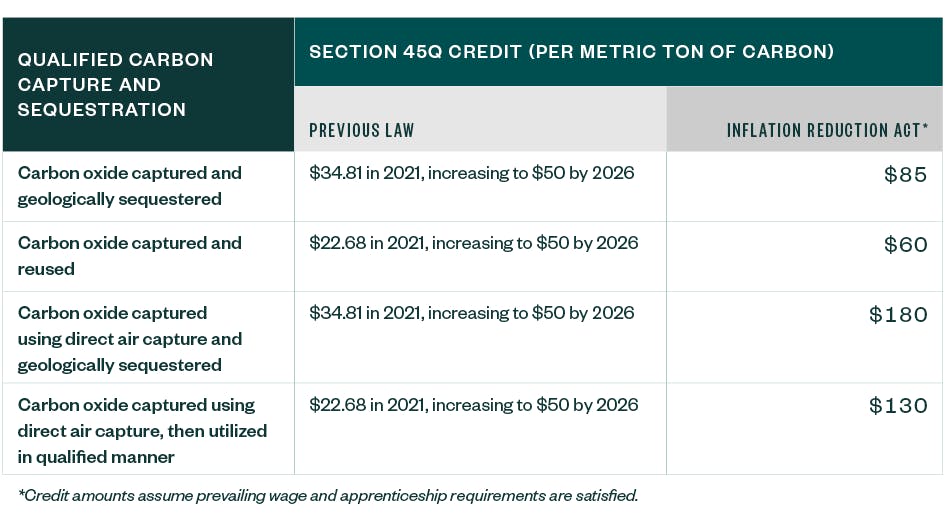
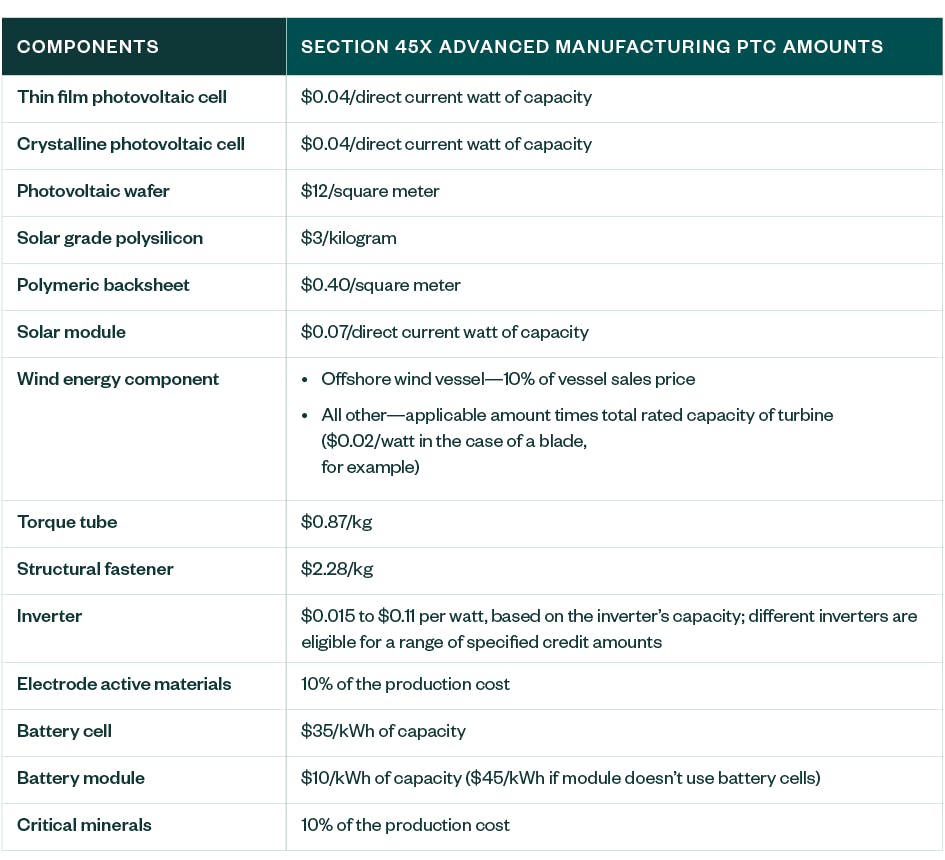
The act also expands the scope and value of existing incentives and adds new ones that fossil fuel companies may find attractive.
Following are some notable changes from previous law and differences from proposals in the BBBA. You can also explore an overview of the tax implications in the act.
Notable changes from previous law
PTC and ITC
- Availability. Full PTCs and ITCs are available for all projects placed in service after 2021 and prior to 2025. The PTC is also now available for solar projects that begin construction prior to 2025. This could be more beneficial than the ITC for many projects. Likewise, the ITC is now available for wind projects.


Related sections

Inflation Reduction Act: energy provisions
The information provided here is of a general nature and is not intended to address the specific circumstances of any individual or entity. In specific circumstances, the services of a professional should be sought. Tax information, if any, contained in this communication was not intended or written to be used by any person for the purpose of avoiding penalties, nor should such information be construed as an opinion upon which any person may rely. The intended recipients of this communication and any attachments are not subject to any limitation on the disclosure of the tax treatment or tax structure of any transaction or matter that is the subject of this communication and any attachments.