Article
IRS releases guidance on new foreign income tax allocation under OBBBA
Dec. 19, 2025 · Authored by James C. Lawson, Nikki Grams
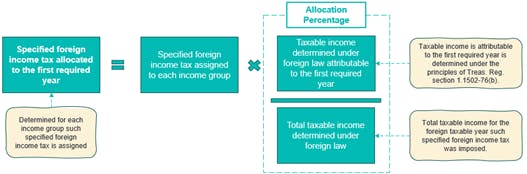
The IRS and Treasury recently issued Notice 2025-72, delivering critical guidance on the One Big Beautiful Bill Act’s (OBBBA) repeal of the one-month deferral election under section 898. The guidance offers relief in providing for the allocation of foreign income taxes of affected foreign corporations between a one-month short period and the succeeding taxable year, thereby mitigating the potential loss of foreign tax credit. The Notice also clarifies how the amortization election made with respect to any section 987 pretransition gain or loss will be impacted as a result of short taxable periods (including that for the first required year upon loss of the one-month deferral previously elected under section 898).
Removal of the one-month deferral election under section 898
Section 898 generally requires controlled foreign corporations (CFCs) to conform their U.S. taxable year to that of their majority U.S. shareholder unless the requirements for an exception have been met. Historically, taxpayers for which conformity is required could elect to use a taxable year beginning one month earlier than the required taxable year. The OBBBA removes the one-month deferral election, and, as a result, forces taxpayers that own specified foreign corporations (e.g., CFCs) for which the one-month deferral election had been made, to report a one-month short taxable year for applicable CFCs for each’s first taxable year beginning after Nov. 30, 2025. This means that an accrual basis specified foreign corporation, or CFC, electing, for example, to use a Nov. 30 year-end, when the required year-end is Dec. 31, (an affected corporation) will result in the filing of two Forms 5471 for the U.S. shareholder’s 2025 taxable year: one for the period of Dec. 1, 2024, through Nov. 30, 2025, and a second for Dec. 1, 2025, through Dec. 31, 2025. For more on the removal of the one-month deferral election and other OBBBA changes impacting CFCs, please refer to this article explaining the revamp and rebrand of the GILTI regime in the One Big Beautiful Bill Act.
For foreign tax credit purposes, accrual basis taxpayers generally consider qualifying foreign income taxes once they are first fixed and determinable under the all-events test, which is generally at the end of the foreign taxable year to which such taxes relate. This can create foreign tax creditability issues in a one-month short period (such as that imposed above) in which a full year of income taxes accrue and might otherwise be creditable (e.g., a CFC’s entire tax liability for the foreign taxable year of Jan. 1, 2025, through Dec. 31, 2025) but only one month of the corresponding CFC income is includible (e.g., for the December 2025 one-month period).

Related sections
The information provided here is of a general nature and is not intended to address the specific circumstances of any individual or entity. In specific circumstances, the services of a professional should be sought. Tax information, if any, contained in this communication was not intended or written to be used by any person for the purpose of avoiding penalties, nor should such information be construed as an opinion upon which any person may rely. The intended recipients of this communication and any attachments are not subject to any limitation on the disclosure of the tax treatment or tax structure of any transaction or matter that is the subject of this communication and any attachments.