
Article
How to determine the benefit of an SSI percentage recalculation
Sept. 7, 2020 · Authored by Lindsay Webb, Michael Newell
As a primary component of Medicare Disproportionate Share Hospital (DSH) reimbursement, a hospital’s Supplemental Security Income (SSI) percentage plays a significant role in determining the reimbursement impact.
Hospitals should research annually whether their facility could benefit from an SSI percentage recalculation, also known as an SSI recalculation, realignment, or redetermination. If this hasn’t been historically or consistently reviewed, it’s recommended that hospitals perform a look back through their SSI data.
What is the SSI fraction?
Also referred to as the Medicare fraction of the Medicare DSH calculation, the SSI fraction represents the percent of patient days for beneficiaries who are eligible for both Medicare Part A and Part C and SSI.
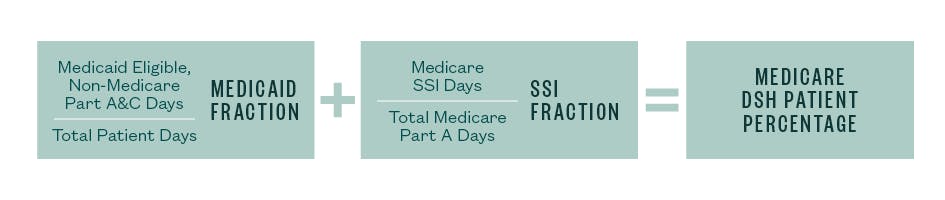
By default, SSI fractions are based on the federal fiscal year (FFY) end — Oct. 1 to Sept. 30 — and are generally published annually by the Centers for Medicare & Medicaid Services (CMS).
This concept makes sense for providers whose cost reporting period mirrors the federal fiscal year, but what about providers with cost reporting periods that differ from the Sept. 30 FFY end?
Current CMS regulations allow a hospital to request its Medicare fraction or SSI ratio be recalculated or realigned based on the hospital’s cost reporting period when it’s different from the federal fiscal year.
In practice, if a hospital’s fiscal year-end is Dec. 31, 2017, the Sept. 30, 2017, SSI ratio would be used in the Medicare Disproportionate Share calculation. According to the CMS regulations mentioned above, the SSI ratio could be recalculated to mirror the hospital’s fiscal year beginning on Jan. 1, 2017, and ending Dec. 31, 2017, by using a combination of two federal fiscal years of the Medicare Provider Analysis and Review (MedPAR) file.
Both the Sept. 30, 2017, and the Sept. 30, 2018, SSI ratio data would need to be analyzed to determine the hospital fiscal year SSI ratio.

