Article
Long-term care facilities: Are you ready for new CMS staffing standards?
Nov. 4, 2024 · Authored by Marisol Cooke
The Centers for Medicare & Medicaid Services (CMS) recently issued a final rule, Medicare and Medicaid Programs; Minimum Staffing Standards for Long-Term Care Facilities and Medicaid Institutional Payment Transparency Reporting (final rule) that went into effect on June 21, 2024. This rule is intended to establish minimum staffing standards for long-term care (LTC) facilities as part of the Biden-Harris Administration's nursing home reform initiative to ensure safe and quality care in LTC facilities.
The rule also requires states to report the percent of Medicaid payments for certain Medicaid-covered institutional services that are spent on compensation for workers and support staff.
The rule represents a pivotal change in LTC staffing standards and underscores a profound shift towards a holistic and person-centered care for residents. Use the following insights to help your organization comply with these new standards.
Background
Based on a study by Kaiser Family Foundation (KFF), just 60% of facilities currently meet the overall staffing requirements of 3.48 hours per resident a day, but fewer facilities meet the final requirements that include minimums for registered nurses and nurse aids.
The study also found nursing facilities are hiring more than 80,0777 nurse aids and 22,077 registered nurses. These statistics reveal the urgency of the situation and potential compliance repercussions.
New staffing requirements
With a focus on not just meeting the bare minimums, but on the presence of skilled nursing professionals around the clock, the mandate recognizes the crucial role of registered nurses in safeguarding a resident’s well-being.
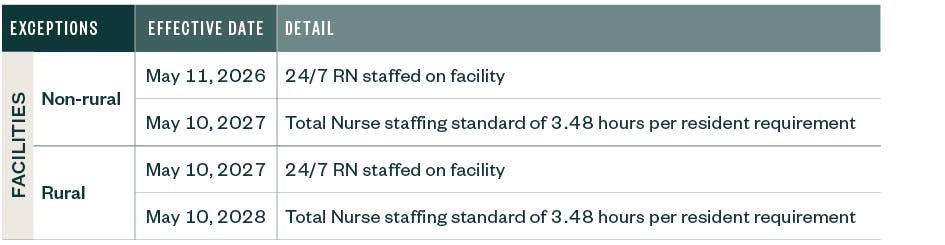
The new rule requires the following standards for nurse staffing:
- Minimum 3.48 hours per resident a day total direct nursing care to residents
- A registered nurse on staff 24 hours per day, seven days per week
Exceptions to implementation effective date of July 21, 2024

Related sections