
Article
Uncompensated care trends in 2026: What you need to know
Aug. 19, 2025 · Authored by Heather Keser
The 2026 Inpatient Prospective Payment System (IPPS) proposed rule includes changes in several critical areas for hospitals, including uncompensated care (UCC) payments, Medicaid redeterminations, and 340B eligibility. These issues are directly tied to reimbursement and financial viability, making it essential for healthcare executives to proactively manage them.
Hospitals that can adapt to these changes with data-driven strategies based on audit trends and insights will be better positioned to thrive in an increasingly complex reimbursement environment.
Trends and insights from audits
Our federal fiscal year (FFY) 2019 through 2022 S-10 cost report comparison pre- and post- audit analysis found that hospitals experienced significant reductions in reported uncompensated care costs. For example, from 2019 to 2022, the average change to Worksheet S-10 Line 30, total uncompensated care, ranged from a decrease of $699,675 in 2019 to $431,466 in 2022. This indicates increased scrutiny by Medicare Administrative Contractors (MACs) on S-10 cost reports.
Changes in line 30 UC
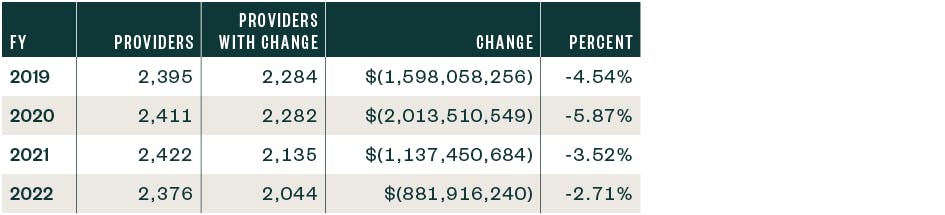
Key findings also include:
- Charity Care Adjustments. Charity care for uninsured patients saw an upward revision of 1.15% in 2022, but insured charity care decreased by 22.17%.
- Bad Debt Documentation. Hospitals reported consistent downward adjustments for bad debts, with a 3.48% reduction in 2022 alone.
These trends highlight the importance of accurate and thorough documentation. Hospitals must ensure their financial assistance and bad debt policies align with regulatory expectations to avoid unfavorable audit outcomes.
Analysis and insights from the proposed rule
The 2026 IPPS proposed rule introduces several updates that could significantly impact hospitals' reimbursement strategies.
Related sections
