
Article
Transaction cost considerations when buying or selling a business (with FAQ)
Aug. 24, 2023 · Authored by Matt Billings
There are many considerations and legal processes to navigate when buying or selling a business. Most changes in ownership include incurring some amount of transaction costs for legal fees, due diligence, structuring, investment bankers, employee bonuses, and payouts.
The tax law around deducting transaction costs can be complex, but a basic understanding may help support the current tax deduction of transaction costs and free up cash flows on both buy-side and sell-side.
Treatment of transaction costs
Understanding the basic treatment of transaction costs for both bookkeeping and tax is important, which is further detailed below.
GAAP treatment
For bookkeeping purposes, buy-side transaction costs are generally expensed as incurred or upon transaction close and sell-side costs are recorded through the flow-of-funds as an adjustment to sales proceeds.
Tax treatment
In general, for income tax purposes, any costs paid to facilitate a transaction must be capitalized into the basis of the purchased assets or stock by the buyer or treated as a reduction in sales proceeds by the seller. The taxpayer has the burden of proof to document which transaction costs, if any, can be expensed as non-facilitative.
Frequently asked questions
Below are questions to help you navigate the transaction cost process.
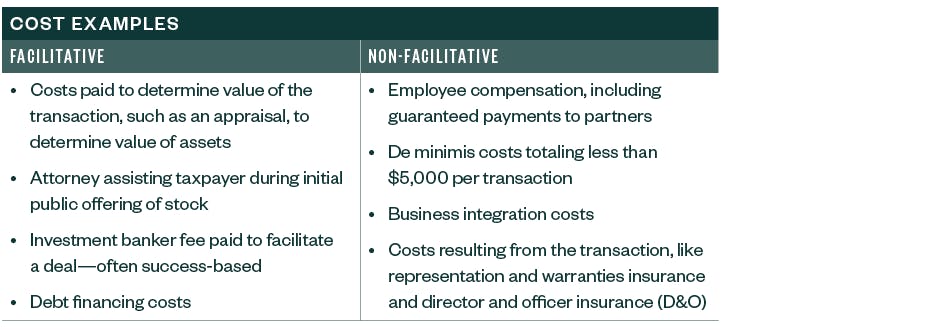
What costs are considered facilitative and therefore must be capitalized for income tax purposes?
Facilitative costs refer to those paid in the process of investigating or otherwise pursuing the transaction, which is a facts and circumstances test. The fact that the amount would be or would have been paid but for the transaction is relevant, but it’s not always determinative.

The information provided here is of a general nature and is not intended to address the specific circumstances of any individual or entity. In specific circumstances, the services of a professional should be sought. Tax information, if any, contained in this communication was not intended or written to be used by any person for the purpose of avoiding penalties, nor should such information be construed as an opinion upon which any person may rely. The intended recipients of this communication and any attachments are not subject to any limitation on the disclosure of the tax treatment or tax structure of any transaction or matter that is the subject of this communication and any attachments.