Scoring criteria
Scoring criteria differed between rounds one and two and round three.
Round one and two
Application scoring in rounds one and two focused heavily on the types of locations to be served, including farms, businesses, healthcare centers, educational facilities, and essential community facilities.
Round three
The types of locations above weren’t considered in round three.
Round three scoring criteria focuses on:
- The proposed funded service area — how rural is it?
- The level of existing service available in the proposed funded service area
- The economic need of the area to be served
- Affordability of the services to be offered
- Applicant’s commitment to strong labor standards — with bonus points for non-private entities
- Vulnerability of the community
- Applicant’s commitment to providing wholesale broadband services and net neutrality standards
There are 10 scoring criteria being used in ReConnect round three, with various point amounts available on an all-or-nothing basis to total 17 points.
Only the funding categories that include grant funding are competitively scored using these criteria, while the 100% loan program is awarded on a first-come, first-served basis rather than being competitively scored.
The following criteria are considered for the competitively scored funding programs.
Rurality
Twenty-five points are awarded if the entirety of the proposed funded service area is more than 100 miles from a population center of 50,000 or more or if the population density is six or fewer.
Level of existing service
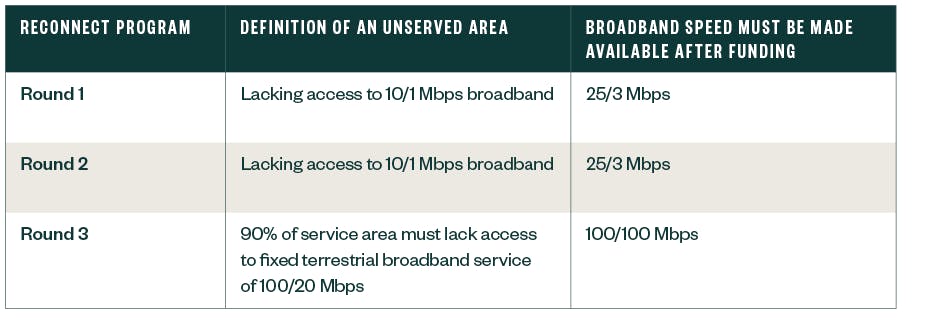
Twenty-five points are awarded if all locations within the proposed funded service area lack access to 25/three Mbps or greater broadband service.
Economic need
Twenty points are awarded if 75% or more of the proposed funded service area scores 20% or higher on the Census Small Area Income and Poverty Estimates Program.
Affordability
Twenty points are awarded if:
- The rates to be offered within the proposed funded service area are determined to be affordable to customers in the area
- The applicant commits to offering a low-cost service offering with broadband speeds sufficient for simultaneous remote learning and telework
- The applicant commits to participating in the Federal Communications Commission’s (FCC) Affordable Connectivity Program and Lifeline Program
Labor standards
Twenty points are awarded if the applicant commits to strong labor standards for the proposed project, including compliance with the Davis-Bacon Wage Act and various other labor commitments.
Tribal lands
Fifteen points are awarded to Tribal Government applicants, and 10 points are awarded to non-Tribal applicants, that will serve at least 50% Tribal lands.
Non-private applicants
Fifteen points are awarded to non-private, local government, and cooperative owned applicants.
Socially vulnerable communities
Fifteen points are awarded when 75% or more of the proposed funded service area falls within Socially Vulnerable Communities, as defined by the CDC.
Net neutrality
Ten points are awarded if the applicant commits to the FCC’s net neutrality principles.
Wholesale broadband service
Ten points are awarded if the applicant commits to offering a reasonable and nondiscriminatory wholesale broadband service.
Challenges
There are a few challenges respondents face when applying for the ReConnect Program.
Competition
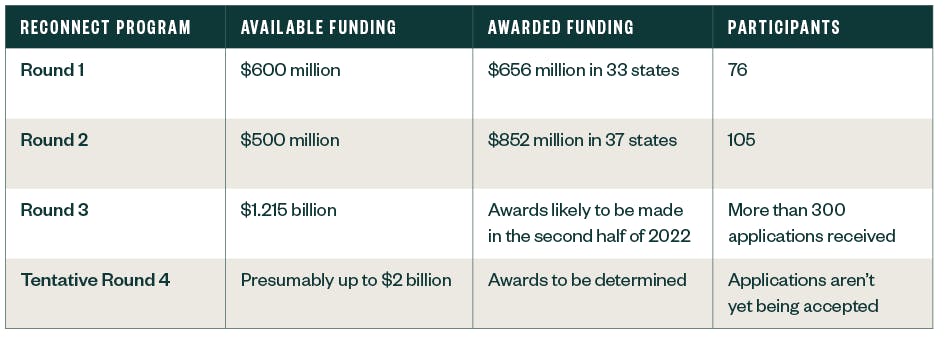
The USDA deemed 304 applications complete, beginning the 45-day public notice response process.
Evidence of service
Broadband providers may submit a response to the public notice showing they can provide at least 100/20 Mbps to at least one location within the proposed funded service area.
Service area map
Respondents must provide a map of their service area that overlaps with the proposed funded service area.
In addition, respondents must provide:
- The number of locations within the proposed funded service area to which they’re capable of providing 100/20 Mbps broadband service
- The number of existing customers to which they provide broadband service in the overlap area
- The maximum download and upload speeds that they offer in the overlap area
- The name of a company technician that will be made available to assist in the USDA’s review of the response filing
Speed tests performed in the overlap area are accepted but optional.
Scoring criteria
Scoring criteria differed between rounds one and two and round three.
Round one and two
Application scoring in rounds one and two focused heavily on the types of locations to be served, including farms, businesses, healthcare centers, educational facilities, and essential community facilities.
Round three
The types of locations above weren’t considered in round three.
Round three scoring criteria focuses on:
- The proposed funded service area — how rural is it?
- The level of existing service available in the proposed funded service area
- The economic need of the area to be served
- Affordability of the services to be offered
- Applicant’s commitment to strong labor standards — with bonus points for non-private entities
- Vulnerability of the community
- Applicant’s commitment to providing wholesale broadband services and net neutrality standards
There are 10 scoring criteria being used in ReConnect round three, with various point amounts available on an all-or-nothing basis to total 17 points.
Only the funding categories that include grant funding are competitively scored using these criteria, while the 100% loan program is awarded on a first-come, first-served basis rather than being competitively scored.
The following criteria are considered for the competitively scored funding programs.
Rurality
Twenty-five points are awarded if the entirety of the proposed funded service area is more than 100 miles from a population center of 50,000 or more or if the population density is six or fewer.
Level of existing service
Twenty-five points are awarded if all locations within the proposed funded service area lack access to 25/three Mbps or greater broadband service.
Economic need
Twenty points are awarded if 75% or more of the proposed funded service area scores 20% or higher on the Census Small Area Income and Poverty Estimates Program.
Affordability
Twenty points are awarded if:
- The rates to be offered within the proposed funded service area are determined to be affordable to customers in the area
- The applicant commits to offering a low-cost service offering with broadband speeds sufficient for simultaneous remote learning and telework
- The applicant commits to participating in the Federal Communications Commission’s (FCC) Affordable Connectivity Program and Lifeline Program
Labor standards
Twenty points are awarded if the applicant commits to strong labor standards for the proposed project, including compliance with the Davis-Bacon Wage Act and various other labor commitments.
Tribal lands
Fifteen points are awarded to Tribal Government applicants, and 10 points are awarded to non-Tribal applicants, that will serve at least 50% Tribal lands.
Non-private applicants
Fifteen points are awarded to non-private, local government, and cooperative owned applicants.
Socially vulnerable communities
Fifteen points are awarded when 75% or more of the proposed funded service area falls within Socially Vulnerable Communities, as defined by the CDC.
Net neutrality
Ten points are awarded if the applicant commits to the FCC’s net neutrality principles.
Wholesale broadband service
Ten points are awarded if the applicant commits to offering a reasonable and nondiscriminatory wholesale broadband service.
Challenges
There are a few challenges respondents face when applying for the ReConnect Program.
Competition
The USDA deemed 304 applications complete, beginning the 45-day public notice response process.
Evidence of service
Broadband providers may submit a response to the public notice showing they can provide at least 100/20 Mbps to at least one location within the proposed funded service area.
Service area map
Respondents must provide a map of their service area that overlaps with the proposed funded service area.
In addition, respondents must provide:
- The number of locations within the proposed funded service area to which they’re capable of providing 100/20 Mbps broadband service
- The number of existing customers to which they provide broadband service in the overlap area
- The maximum download and upload speeds that they offer in the overlap area
- The name of a company technician that will be made available to assist in the USDA’s review of the response filing
Speed tests performed in the overlap area are accepted but optional.